|
$$PLAIN_TEXT_PREVIEW$$
Madaniya’s Monthly Newsletter
|
Dear colleagues, representatives of civil society organisations, We hope this finds you in good health and spirits. The month of May marked a significant moment for the Syrian people, with the beginning of the lifting of US and European sanctions on Syria. This is a meaningful step towards rebuilding a new Syria—reviving its institutions and key sectors, and working towards a dignified life for all Syrians. We are also pleased to welcome 35 new member organisations to Madaniya, further strengthening our collective presence and shared purpose. Below is our May newsletter, where we share the latest updates from Madaniya and developments across the Syrian civic space. Best wishes,
Madaniya’s Team
|
Updates on Madaniya’s Work
|
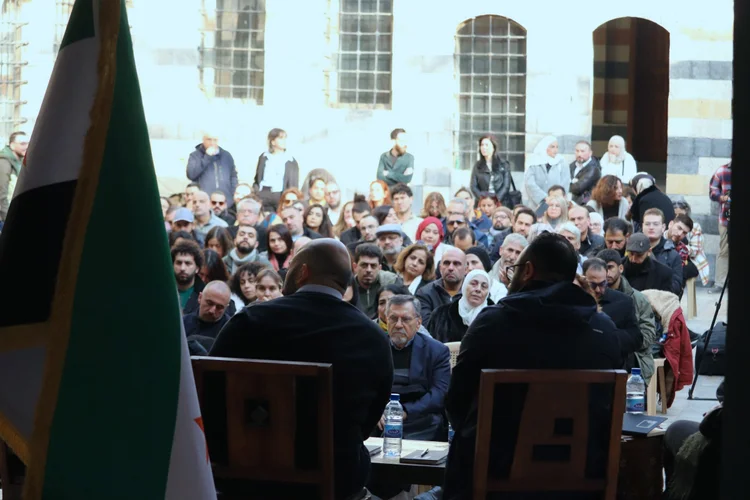
Madaniya Board of Directors Elections Madaniya, in coordination with the Independent Elections Committee, is resuming its Board of Directors election process after a temporary pause brought on by the sweeping changes that followed the fall of the Assad regime. These developments have reshaped the political and civic landscape across Syria, prompting a comprehensive revision of the electoral framework—particularly concerning the distribution of districts and the balance of representation among member organisations. In this context, we extend our congratulations to the former board members who concluded their term at Madaniya to join the Syrian transitional government. We also offer our heartfelt thanks to all other outgoing members who will not be participating in the upcoming election due to shifts in their professional and civic roles. This transition is seen as a continuation of their public engagement—albeit from new positions and with different responsibilities. As a result of these changes, the upcoming board elections will involve 16 vacant seats, representing 50% plus one of the total number of board positions. These seats will be allocated across electoral districts according to the geographic distribution of Madaniya’s member organisations. We also express our sincere appreciation to the Independent Elections Committee for its continued efforts and dedication. The committee now consists of Mazhar Sharbaji, Asmaa Al-Mahmoud, and Jivan Haj Youssef, following the resignation of Yasser Farhan due to his appointment to the National Fact-Finding Committee on coastal events. We wish him the very best in his new role.
|
|

|
|
|
|
Member Organisations Madaniya is pleased to welcome 35 new organisations to its membership, bringing the total number of member organisations to over 240. This growing collective reflects a broad and diverse spectrum of Syrian civil society actors, representing a wide range of geographic regions and fields of work. This expansion comes as part of our ongoing commitment to the inclusive representation of Syria’s rich social diversity within our organisational structure. A full list of Madaniya’s member organisations is always accessible via the provided link. Madaniya was founded on a clear vision: a sovereign, democratic, and pluralistic Syria where all citizens are equal under the rule of law. Over nearly two years of collective work, member organisations have rallied around a shared set of values that form the ethical and political foundation of our joint efforts. Guided by a deep belief in the civic space’s political legitimacy, Madaniya continues—alongside its member institutions—to uphold and protect that space, while strengthening the role of civil society in shaping Syria’s future on the basis of justice, freedom, and inclusive participation. We continue to receive and review new membership applications as part of our effort to expand our collective work in a way that serves our shared vision for Syria’s future and reinforces the role of civil society as a key partner in rebuilding the state and society. We invite you to share the application link with any civil society actors interested in joining Madaniya’s collective. |
|
|
|
|
|
Comprehensive Dialogue on the Role of Civil Society and Madaniya in Monitoring Political Transition Indicators In partnership with The Day After, Madaniya is preparing to launch a comprehensive dialogue track aimed at rethinking the role of civil society—and that of Madaniya specifically—in monitoring and advancing indicators of democratic transformation during Syria’s political transition. This initiative seeks to strengthen the civic space’s political agency and reaffirm the central role of civic actors in rebuilding both the state and society. The dialogue responds to a growing need for an honest, collective reflection on the position of civic actors, raising essential questions about our roles, alignments, and operational models in light of the current transformations. At its core, the track revolves around two main questions: How can Madaniya translate its vision and values into clear standards and practical indicators that push the transition process forward? And what role can civil society meaningfully play in this context? The process will also include a review of Madaniya’s internal structures and operational mechanisms, aiming to draw lessons from past experiences and establish more effective foundations for collective action. The dialogue is designed to be inclusive, participatory, and open-ended—providing space and time for in-depth discussion and producing outcomes that go beyond internal restructuring. It seeks to contribute to shaping a broader roadmap for Syrian civic work grounded in shared principles and values. The launch event for this dialogue track will take place next month at Madaniya’s headquarters in Damascus. Further details regarding the date and official invitations will be shared soon, along with regular updates on the progress of this initiative.
|
|
|
|
|
Madaniya's Engagement with Ongoing Events
|
Consultation Session with Member Organisations in Response to Developments around Damascus and Sweida On 2 May 2025, Madaniya convened an emergency session with representatives from 21 member organisations, in response to the escalating sectarian tensions and incidents of violence in Jaramana, Sahnaya, Ashrafiyet Sahnaya, and the governorate of Sweida. The session was held to address the pressing need for a unified civic stance and to outline a clear, coordinated approach for effective action during this critical phase. The discussion focused on the importance of addressing the political roots of the crisis and the potential role of civil society in promoting a unifying national discourse. Participants stressed the need to restore transitional justice as a pathway to stability. The session also examined the nature of civil society’s relationship with state authorities and underlined the urgency of advocating for legislation that criminalises hate speech. In parallel, participants highlighted the importance of protecting and expanding independent civic spaces. A key outcome of the session was the emphasis on building an inclusive national narrative that reflects the perspectives of all communities, as well as strengthening the geographic reach of Madaniya’s member organisations to ensure more effective engagement in peacebuilding efforts across the country. The session concluded with an agreement to develop a carefully structured outreach plan to engage relevant ministries and secure a more active civic role in addressing similar future crises. Work on the plan is now complete and will soon be shared with member organisations as we prepare for its collective and coordinated implementation.
|

|
European Advocacy Campaign to Reframe Sanctions Policy on Syria As part of its ongoing efforts to lift the sectoral sanctions imposed on Syria, Madaniya launched a series of strategic actions ahead of the European Union’s decision to lift certain sanctions—particularly those targeting public institutions and key sectors. Madaniya initiated outreach to a number of European countries by sending formal letters to all EU member states, calling for the immediate and comprehensive removal of sanctions. These communications stressed that the continuation of such measures is increasingly incompatible with Syria’s urgent humanitarian and developmental needs, and that sanctions are obstructing recovery and reconstruction efforts. In this context, and in coordination with several of its member organisations, Madaniya launched a focused advocacy campaign aimed at reshaping the positions of several European countries known for their reservations regarding the sanctions file. The campaign emphasised the need for any sanctions relief to be firmly anchored in commitments to accountability and human rights. This round of advocacy involved opening channels of communication with three of the most hesitant countries in this regard—Cyprus, Greece, and Lithuania—through formal letters and preliminary meetings.
|
|
|
These efforts culminated in a direct meeting on 23 May 2025 between Madaniya and representatives of the Republic of Lithuania, with participation from a Syrian civil society delegation that included the Syrian Legal Development Programme (SLDP), the Syrian American Medical Society (SAMS), and other member organisations. The discussion focused on the imperative of ensuring that human rights due diligence continues to be integrated into all international policies concerning Syria, particularly in the post-sanctions phase. Participants explored how future steps toward easing sanctions can be aligned with protecting civic space and promoting a recovery grounded in rights. The Syrian delegation highlighted the adverse consequences of over-compliance with sanctions, which have severely restricted the operating space for civil society inside Syria and forced many civic actors into exile—deepening fragmentation and diminishing local impact. They emphasised that responsible, strategic sanctions relief could offer an opportunity to rebuild a truly independent and inclusive civic space, reinforce mechanisms of accountability, and anchor the recovery process in justice and human dignity. For its part, Lithuania reaffirmed its principled stance in favour of a gradual and orderly lifting of sanctions, contingent upon clear guarantees related to human rights and accountability within Syria’s emerging governance structures. Lithuanian representatives also expressed their interest in supporting the Syrian people and enabling economic recovery, provided it occurs within a legal and democratic framework.
|
|
|
|
|
|
|
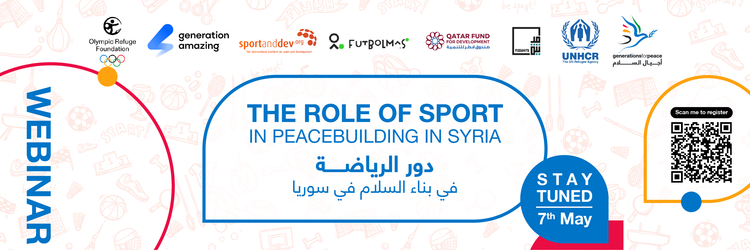
International Discussion: "The Role of Sport in Peacebuilding in Syria – Rebuilding Lives and Bridging Divides" On 7 May 2025, Madaniya, in partnership with Generations For Peace—a leading Jordanian organisation in the fields of peacebuilding and youth empowerment through sport and civic participation—organised an international online discussion titled: "The Role of Sport in Peacebuilding in Syria: Rebuilding Lives and Bridging Divides." The event aimed to explore how youth and civil society can contribute to strengthening social cohesion and creating a supportive environment for the restoration of life and the return of displaced persons, using tools that include sports and participatory community initiatives. Several of Madaniya’s member organisations took part in the discussion. Olive Branch delivered a keynote intervention, presenting field experiences in using sport as a tool for rebuilding trust and reconnecting divided communities. Other member organisations contributed to specialised working groups that tackled four key themes: inclusive sports programming, trauma and resilience, youth engagement, and strategies for funding and cooperation in conflict-affected contexts. The discussion drew strong international participation, including representatives from the UN High Commissioner for Refugees (UNHCR), the Refugee Olympic Team, and practitioners from international organisations working on youth and peacebuilding, such as Peace and Sport. A detailed report documenting the outcomes and key recommendations of the discussion is currently being prepared in collaboration with Generations For Peace and will soon be shared with all participating organisations and partners.
|
|
|
|
|
|
Madaniya’s Engagements with International Stakeholders As part of its ongoing efforts to foster dialogue and cooperation with international actors engaged in the Syrian file, Madaniya continues to hold a series of meetings with a range of global partners. These meetings serve as a platform to discuss political and civic developments in Syria and to explore effective avenues for supporting the priorities of Syrian civil society.
|
Meeting with the European Union – Introduction to the Directorate-General for the Middle East and North Africa
Madaniya participated in a meeting held in Damascus that brought together representatives of Syrian civil society and Mr Stefano Sannino, Director-General for the Middle East and North Africa at the European Commission. The discussion focused on enhancing the role of civil society in Syria, supporting the development of local institutions, and exploring opportunities for future collaboration in institutional empowerment and local capacity building. Introductory Meeting with the Head of the ICRC Delegation in Syria
Madaniya held an introductory meeting with the Head of the International Committee of the Red Cross (ICRC) Delegation in Syria. The discussion centred on future coordination and potential joint work, particularly in the areas of field cooperation, civilian protection, and supporting communities affected by the conflict. Meeting with the European Institute of Peace
As part of the European Institute of Peace’s visit to Damascus, Madaniya met with EIP representatives to discuss potential collaboration on upcoming projects planned for implementation in Syria, and how to involve Madaniya’s member organisations in the design and execution of these initiatives.
|
Madaniya’s Engagements with Syrian Stakeholders As part of its efforts to expand channels of communication with local Syrian actors and strengthen national partnerships, Madaniya continues to convene meetings aimed at exploring opportunities for collaboration in civic and political engagement, particularly in areas experiencing social and administrative shifts.
|
Meeting with the Ministery of Disaster Management and Emergency Response
Madaniya took part in the first official meeting between the Ministery of Disaster Management and Emergency Response and a group of Syrian civil society and humanitarian response organisations. The meeting was convened to discuss the development of a national response plan and to explore ways to establish effective partnerships between the government and relevant civic actors. This meeting marked an initial step toward the formulation of a participatory response strategy that reflects the priorities of local communities and the realities of humanitarian work on the ground. The discussions led to the creation of a joint committee tasked with drafting the response strategy, composed of representatives from both the ministry and civil society organisations, ensuring a coordinated and inclusive approach in the period ahead.
|
Updates from Member Organisations
|
This section highlights key achievements and recent developments in the work of Madaniya’s member organisations, alongside events that have taken place at Madaniya’s headquarters in Damascus.
|
|

|
Annual Civil Defense Conference in Damascus
On 2 June 2025, the Syrian Civil Defense (White Helmets) will hold its annual general conference in Damascus, marking the first time the event is hosted inside Syria. The conference will explore the organisation’s current role and its future vision in light of the recent transformations in the country.
The event includes a panel discussion with guests and partners from international and local organisations and institutions, along with presentations highlighting key areas of the Civil Defence’s work and its ongoing contributions to community recovery.
|
|
|
2025 Peace in Progress Award – Women Now for Development
Women Now for Development has been awarded the 2025 "Peace in Progress" Prize by the International Catalan Institute for Peace (ICIP). This recognition honours the organisation’s ongoing commitment to nonviolent struggle for peace and stability in Syria, as well as its crucial role in supporting and empowering women within a complex and volatile national context.
The award represents an international acknowledgement of the critical contributions made by Syrian women in resisting marginalisation and violence, and underscores the importance of rights-based and developmental approaches adopted by grassroots organisations working to rebuild conflict-affected communities.
|
|
|
|
|
Events at Madaniya Headquarters – Damascus
|
First Meeting of Families for Freedom in Damascus Since the Fall of the Assad Regime
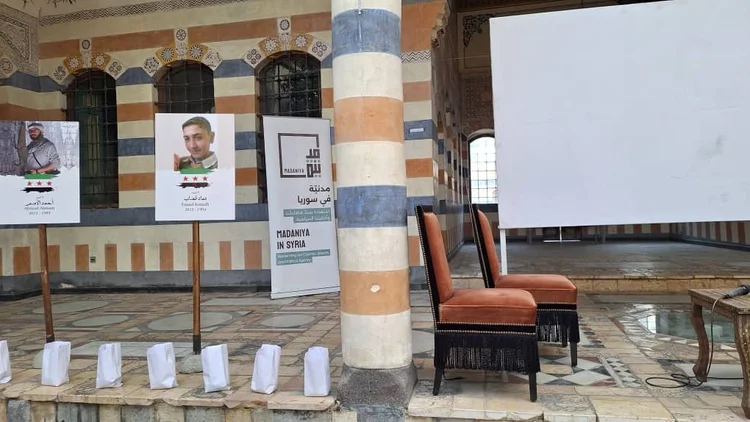
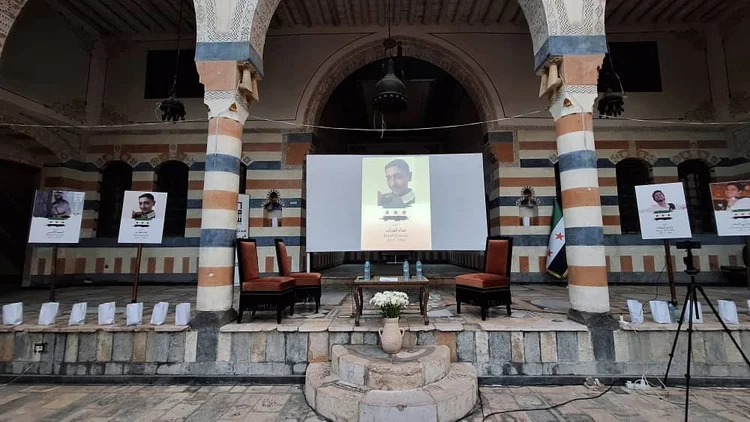
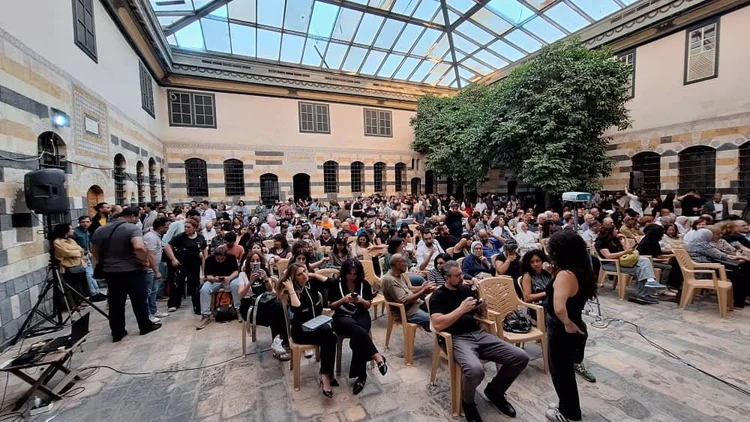
Madaniya hosted the first in-person meeting of Families for Freedom at its headquarters in Damascus — marking the organisation’s first formal presence in the capital since the fall of the Assad regime. The meeting focused on discussing the organisation’s upcoming strategic plan, as well as its new organisational structure aimed at enhancing the impact and reach of its work. “The Road Still Misses You”: First Public Commemoration of Basel Shehadeh in Damascus After the Fall of the Assad Regime On Wednesday, 28 May, Madaniya hosted an event at its Damascus headquarters titled “The Road Still Misses You”, marking the first public commemoration of Basel Shehadeh and his companions Imad Qassab, Ahmad Al-Asam, and Mohannad Arabi Al-Najjar in the capital following the fall of the Assad regime. The event, organised by their close friends, was the first of its kind to take place openly after years of fear and prohibition imposed by the regime’s presence. This gathering represented the first fully-fledged activity held to honour Basel and his companions — a deeply symbolic and emotional moment that coincided with the reopening of civic space in Damascus. The event included a screening of one of Basel’s films, footage documenting the moments of his martyrdom and funeral in Homs, and heartfelt reflections shared by friends who recounted his life, values, and their personal memories with him. The event also featured a visit to his gravesite in Bab Sharqi, where for the first time a headstone bearing his name was placed in the presence of his family, friends, and loved ones. This moment served not only as a symbolic tribute, but also as a first step in reclaiming collective memory and publicly acknowledging one of the cultural and civic figures who embodied the spirit and narrative of the Syrian revolution. Meeting with the Director of the Aid Fund for Syria Madaniya hosted a meeting at its Damascus headquarters bringing together several of its member organisations and the Director of the Aid Fund for Syria (AFS). The session focused on understanding the priorities of member organisations and ensuring their inclusion in shaping the Fund’s strategic direction. Discussions centred on how to make humanitarian financing more responsive to the evolving needs of the Syrian context through collective planning and participation. Meeting with the Finnish Migration Institute Madaniya organised a meeting between its member organisations and representatives from the Finnish Migration Institute. The exchange addressed the current realities surrounding refugee returns, the socio-political challenges faced by returnees, and explored how Finnish migration and asylum policies can become more just in light of these developments. Meeting with the Global Survivors Fund on Recovery and Reparations Madaniya facilitated a dialogue between member organisations and the Global Survivors Fund, dedicated to discussing funding strategies for recovery, reparations, and survivor support. The meeting aimed to align efforts with transitional justice frameworks and define joint priorities for future collaboration focused on justice and redress for survivors of grave violations. Meeting Between Amnesty International and Member Organisations on Transitional Justice and Accountability Madaniya organised a consultative meeting at its Damascus headquarters with Amnesty International, as part of a joint effort to support pathways of transitional justice and accountability in Syria. The session responded to the growing need to create direct dialogue spaces between international organisations and Syrian actors working on transitional justice. The meeting offered a valuable opportunity for the exchange of perspectives on documentation mechanisms, strategies for ensuring accountability and preventing impunity, and ways to address cases of missing persons and grave violations in a framework that centres victims and upholds human rights values. The meeting also provided space for practical recommendations aimed at informing Amnesty International’s engagement during its presence in Syria, with an emphasis on closer coordination with local actors and sensitivity to the national context.
|
In this section, we highlight the latest reports and updates issued by Syrian institutions or concerning Syria during the past month.
|
|
Syria’s Constitutional Declaration and International Law – Syrian Legal Development Programme The Syrian Legal Development Programme (SLDP) released an analytical report examining Syria’s constitutional declaration in the post-Assad period from the perspective of international law, particularly in relation to human rights, the rule of law, and transitional justice. The report aims to assess the compatibility of the declaration with Syria’s international obligations and propose ways to develop it into a legitimate legal framework for the upcoming transitional period. The report begins by analysing the legal framework of the constitutional declaration as a temporary document intended to govern the country during a sensitive transitional phase. It stresses that this declaration should not serve as a permanent substitute for a comprehensive and participatory constitutional process, but rather reflect national consensus and emerge from an open and inclusive political pathway that ensures the representation of all components of Syrian society. It also discusses the sources of political and legal legitimacy for the declaration, highlighting the importance of it being issued through a transparent and representative process that genuinely reflects the popular will and is recognised both domestically and internationally. Regarding rights and freedoms, the report evaluates the extent to which the declaration upholds essential rights, especially freedom of expression and association, the right to a fair trial, and equality before the law. It links these provisions to Syria’s pre-existing commitments as a party to several international treaties. The report also scrutinises the structure of the transitional authorities as outlined in the declaration, emphasising the importance of the separation of powers and judicial independence to prevent the concentration of authority and build trust in state institutions during the reconstruction phase. Furthermore, the report underscores that the constitutional declaration must not overlook the demands of transitional justice. Instead, it must include clear provisions for holding perpetrators of gross human rights violations accountable and ensuring the rights of victims, thus paving the way for a national process grounded in truth and accountability. According to SLDP, the declaration should serve as a legal tool that fosters societal reconciliation and helps restore trust between citizens and the state. On the international front, the report addresses the implications of the declaration for Syria’s global standing and proposes measures to enhance its international recognition, particularly by the United Nations and other key international stakeholders. This, it argues, could facilitate Syria’s reintegration into the international system on a foundation of legal integrity and respect for human rights. To read the full report in English, follow the link provided. |
|
|
|
|
|
|
|
Language Justice in Syria – Justice for Life Organisation Justice for Life has released an analytical report titled Language Justice in Syria, which explores the role of language policies within the framework of transitional justice in Syria. The report underscores the importance of recognising linguistic pluralism as a foundational element in building an inclusive and democratic post-conflict state. The report approaches language justice as an essential dimension of both social and political justice. It argues that guaranteeing the rights of Syria’s various linguistic communities—particularly Kurdish, Syriac, Assyrian, and Turkmen—is key to reconstructing a fair social contract and reinforcing national cohesion. The report contends that decades of state-led linguistic exclusion have entrenched feelings of political and cultural marginalisation, and that addressing this legacy requires a fundamental shift in public policy. It stresses that the recognition of linguistic plurality must go beyond cultural symbolism and be integrated into the political and institutional reforms of the transitional period. This includes ensuring the participation of linguistic communities in decision-making processes, providing public services in their languages, and granting official or local status to their languages in their respective regions. The report ties language justice to broader concepts such as equal citizenship and a shared national identity. It recommends that language policy be embedded as a key principle in any future constitutional declaration or permanent constitution, serving as a basis for inclusive education, administration, and media policies that reflect the country’s cultural and linguistic diversity. |
|
|
|
| | |

Comments