|
$$PLAIN_TEXT_PREVIEW$$
Madaniya’s Monthly Newsletter
|
Dear colleagues, representatives of civil society organisations, We hope this finds you in good health and spirits. Below is our September newsletter, where we share the latest updates from Madaniya and developments across the Syrian civic space. Best wishes,
Madaniya’s Team
|
Updates on Madaniya’s Work
|
|
|
Political Transition Observatory Project In partnership with The Day After organisation, Madaniya continues to implement the Political Transition Observatory Project in Syria, which aims to develop an inclusive dialogue process that strengthens the role of civil society in monitoring indicators of democratic transformation throughout the transitional phase, and in shaping priorities for political and institutional reform based on local perspectives and rights-based approaches. The dialogue sessions began in early September 2025 and have since extended to several Syrian governorates, with the participation of civil society actors and local experts from various sectors. In this context, we are currently engaging with the International Foundation for Electoral Systems (IFES) to explore the possibility of joining the project as a partner, providing additional technical expertise on elections and reinforcing the institutional dimension of the expected outcomes. The project is structured around six key thematic tracks: transitional justice and accountability, judicial reform, constitutional reform, security sector reform, economic reform, and elections. The project will conclude in December 2025 with a National Civil Society Conference where the final outcomes will be presented to both local and international partners—an important step towards consolidating the role of Syrian civil society as a key actor in shaping the contours of the next phase.
|
|
|
|
|
EU Policy on Syria: A Consultative Project in Partnership with the European Institute of Peace In partnership with the European Institute of Peace, Madaniya has launched a consultative project aimed at strengthening the participation of Syrian civil society in shaping and developing the European Union’s policies on Syria in the coming phase. As part of this project, consultations are being held through a series of sessions bringing together civil society organisations, journalists, and local actors. The process began this month and will continue throughout September and October. Six in-person sessions will take place inside Syria across five key regions—north, south, east, centre, and coast—alongside a number of virtual sessions to ensure the broadest possible participation from across the country, reflecting the geographic and sectoral diversity of Syrian civil society. These consultations focus on four principal themes: humanitarian aid and early recovery, development and economic growth, justice and accountability, and political participation—including the representation of women and youth in decision-making.
|
Madaniya's Engagement with Ongoing Events
|
|
|
The Third Annual Conference on the Use of Chemical Weapons in Syria Over the past years, Madaniya, in partnership with several of its member organisations, has worked to develop an annual international conference dedicated to addressing the use of chemical weapons in Syria. The conference serves as a platform bringing together victims’ organisations, civil society, and relevant national and international actors, with the aim of advancing pathways towards justice and accountability and ensuring the non-repetition of such crimes. In this context, the third edition of the annual conference on the use of chemical weapons in Syria was held on 30 September 2025 at the Cham Hotel in Damascus, under the auspices of the Ministry of Emergency and Disaster Management and the Ministry of Foreign Affairs and Expatriates, with broad participation from Syrian and international stakeholders. This year’s conference was organised in partnership with: the “Don’t Suffocate Truth” campaign, the Syrian Center for Media and Freedom of Expression, Badael, the Syrian Legal Development Programme, Women Now for Development, the Syrian American Medical Society (SAMS), MedGlobal, and Madaniya. The third edition of the conference carried particular significance, as it was convened inside Syria for the first time, at a critical juncture in the country’s history following the fall of the Assad regime in December 2024. This created greater opportunities for access to witnesses and evidence and strengthened hopes of launching genuine transitional justice processes and holding perpetrators of chemical weapons attacks accountable. The previous two editions of the conference contributed significantly to documentation efforts, the exchange of expertise, and the formulation of advanced legal and policy recommendations. This year, the conference focused on transforming these efforts into concrete steps, by linking them to a national justice process that places the rights of victims and survivors at its core. This year’s conference brought together representatives of victims’ groups, Syrian civil society organisations, Syrian government institutions, and representatives of governments and international organisations, to discuss ways to strengthen accountability, build on more than a decade of investigative and documentation efforts, and advance towards a comprehensive Syrian vision for justice and redress. To read the recommendations of Syrian civil society addressed to the Syrian government, the National Transitional Justice Committee, and the States Parties to the Organisation for the Prohibition of Chemical Weapons (OPCW), follow the link provided.
|
|
|
|
|
|
|
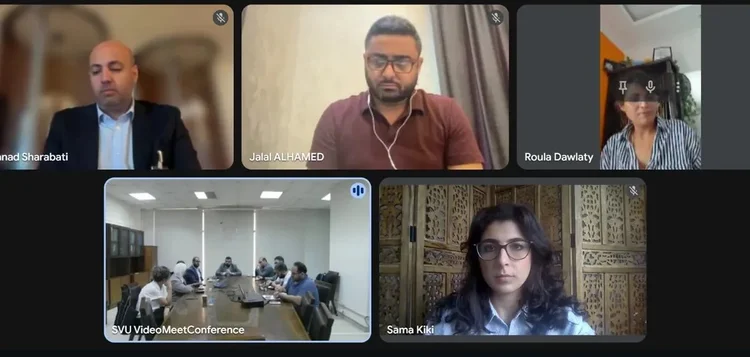
Justice, Truth, and Redress Working Group At the beginning of 2025, Madaniya joined the Justice, Truth, and Redress Working Group, which was established at the initiative of several Syrian civil society organisations, including members of Madaniya: the Syrian Legal Development Programme, the Syrian Centre for Media and Freedom of Expression, Justice for Life, the Syrian Citizenship League, Release me, Lelun, and Dawlaty. The initiative emerged in response to the outcomes and recommendations of the first Syrian Dialogue Conference on Justice, Truth, and Redress, held in January 2025, with the aim of strengthening coordination among Syrian civil actors and developing comprehensive approaches to transitional justice, rooted in the priorities of victims and survivors. Over the past months, the Working Group has developed a reference document entitled General Principles for Justice, Truth, and Redress in Syria. This document outlines a shared preliminary vision of a set of core principles that should guide any future transitional justice process in the country, including principles of transparency, inclusion of victims, guarantees against impunity, de-politicisation, acknowledgement-based justice, and the participation of civil society. In this context, Madaniya, together with its partner organisations in the group, took part in an official meeting with the National Committee for Transitional Justice and the National Committee for the Missing. The meeting aimed to introduce the group, share the principles paper, and propose a joint coordination mechanism that ensures the inclusion of civil society organisations in shaping and implementing any forthcoming arrangements within this process. To read the full General Principles paper, follow the link provided. |
|
|
|
|

|
Advocacy plan on a UN Integrated Mission for Syria, in partnership with Syrian Civil Society Organisations and Crisis Action Madaniya continues to work on a strategic advocacy plan in cooperation with Crisis Action and a number of Syrian organisations, including: the Syrian Women’s Political Movement, the Syrian Centre for Media and Freedom of Expression, The Day After, the Syrian Legal Development Programme, along with a group of independent Syrian experts. These efforts aim to influence the ongoing discussions within the United Nations on restructuring its role in Syria, ensuring that any future arrangements are fairer, more inclusive, and genuinely reflective of the vision of Syrian civil society. |
|
|
In this context, Madaniya convened a meeting with its member organisations, attended by representatives of the organising group, to discuss the core messages. These messages include a clear call for the establishment of an integrated UN mission in Syria, grounded in the principles of transparency, meaningful dialogue, and the direct participation of Syrian civil society from the earliest stages of planning and implementation. The document stresses the need for this mission to be Syrian-led and Syrian-owned—from the design of its mandate and the selection of its leadership, to the execution and monitoring of its work—thereby avoiding the imposition of external solutions or approaches driven by international actors. The messages further emphasise that Syrian civil society—including women, youth, and victims’ groups—must serve as an essential and equal partner in the governance and oversight of the mission, rather than being confined to symbolic or tokenistic consultation. The document proposes that the mission should be based on a clear, comprehensive, rights-centred mandate that supports Syria’s path towards political transition, recovery, and reconstruction, and that ensures diverse and balanced representation of Syrian society. It also highlights the importance of the mission upholding principles of accountability and transparency, including a public acknowledgement of the UN’s past failures in Syria, the application of rigorous human rights due diligence standards, and the avoidance of creating parallel or substitute structures to Syrian national institutions. Madaniya and its partners continue to work on arranging upcoming meetings with the Syrian transitional government, the UN Secretary-General, and members of the Security Council, to convey these messages directly to decision-makers and to affirm the role of civil society as a key partner in shaping the future of the UN’s role in Syria. |
|

|
|
|
Updates from Member Organisations
|
This section highlights key achievements and recent developments in the work of Madaniya’s member organisations, alongside events that have taken place at Madaniya’s headquarters in Damascus.
|
International Women’s Freedom Award – Women Now for Development This month, Women Now for Development received the International Women’s Freedom Award, presented to women human rights defenders, during an official ceremony held in Brussels, attended by representatives of international institutions, ambassadors, and human rights organisations. The award recognises years of continuous work led by Syrian women within the organisation, both inside Syria and abroad, in defending the rights of women and girls, providing them with psychological, social, and legal support, and enabling them to take on leadership and community roles in the context of conflict, displacement, and marginalisation. Through a video published on its official page, the organisation highlighted the journey of its women—raising their voices against silence, documenting violations, advocating for victims, and demanding accountability for perpetrators, despite ongoing threats and abuses. In its remarks, the organisation also outlined the challenges faced by women human rights defenders in Syria, particularly amidst the rise of violent rhetoric, restrictions, and the continued impunity of perpetrators. To watch the award video, follow the link provided.
|
Joint Statement on the Provisional Electoral System for the Syrian Parliament A group of Syrian civil society organisations, including several members of Madaniya—Musawa, Badael, PIL – Civil Waves, the Association of Detainees and Missing of Sednaya Prison, Women Now for Development, the Syrian Centre for Policy Research, Dawlaty, and Justice for Life—issued a joint statement entitled “Decree No. (143): Electoral Reform as a Prerequisite for a Parliament Capable of Supporting Political Transition.” The statement offers a critical analysis of the draft provisional electoral system for the Syrian parliamentary elections during the transitional phase. The statement criticises the proposed draft in its current form for containing structural flaws that hinder fair and genuine representation. It grants the interim president broad powers to appoint one third of the members of parliament and to name replacements for excluded or withdrawn members, undermining the independence of the legislative institution and entrenching executive interference in its structure. The draft also lacks clear criteria for excluding candidates, instead relying on vague conditions open to politicised and potentially discriminatory interpretations. The statement further highlights the limited representation of women and marginalised communities. Women’s representation is capped at 20% under a non-binding recommendation, while other groups—such as survivors of detention, persons with disabilities, and displaced persons—are not explicitly recognised. Moreover, the Higher Electoral Commission lacks independence, as its members are appointed by the executive authority itself and are granted overlapping supervisory, regulatory, and executive powers, which could compromise the impartiality of the electoral process. On this basis, the statement calls for a redrafting of the decree to ensure the creation of a genuine parliament that reflects the aspirations of Syrians and lays the foundation for a meaningful democratic transition. The recommendations include abolishing presidential appointment powers, reforming electoral bodies to include independent civil society actors, amending candidacy conditions to prevent their misuse for political exclusion, strengthening the representation of women and marginalised groups, establishing a fully independent electoral commission, and enabling transparent international and domestic monitoring of the process. To read the full statement, follow the link provided.
|
Events at Madaniya Headquarters – Damascus
|
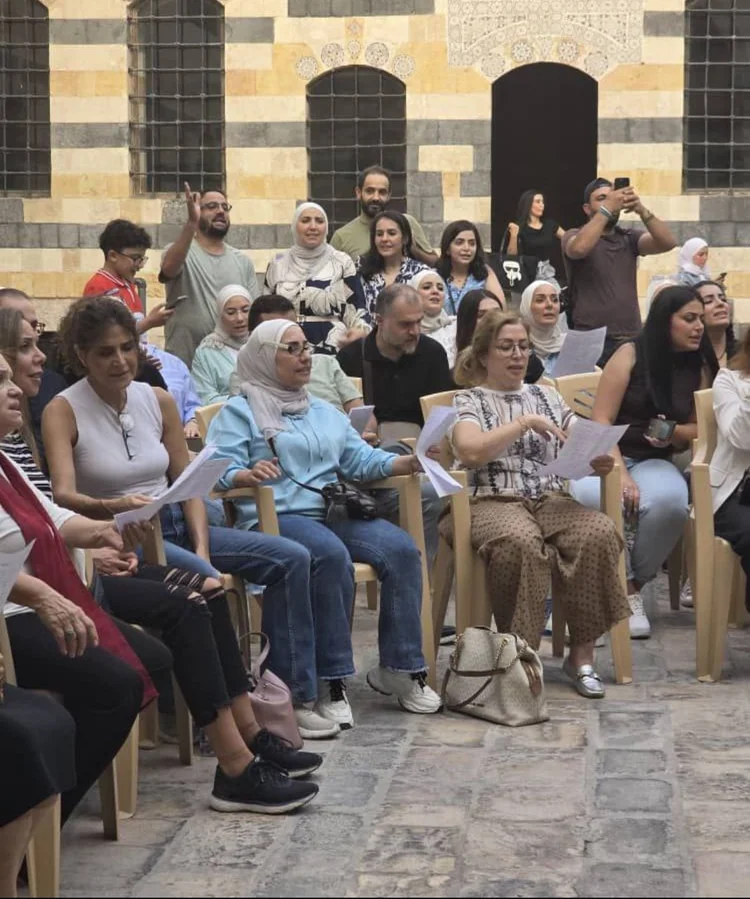
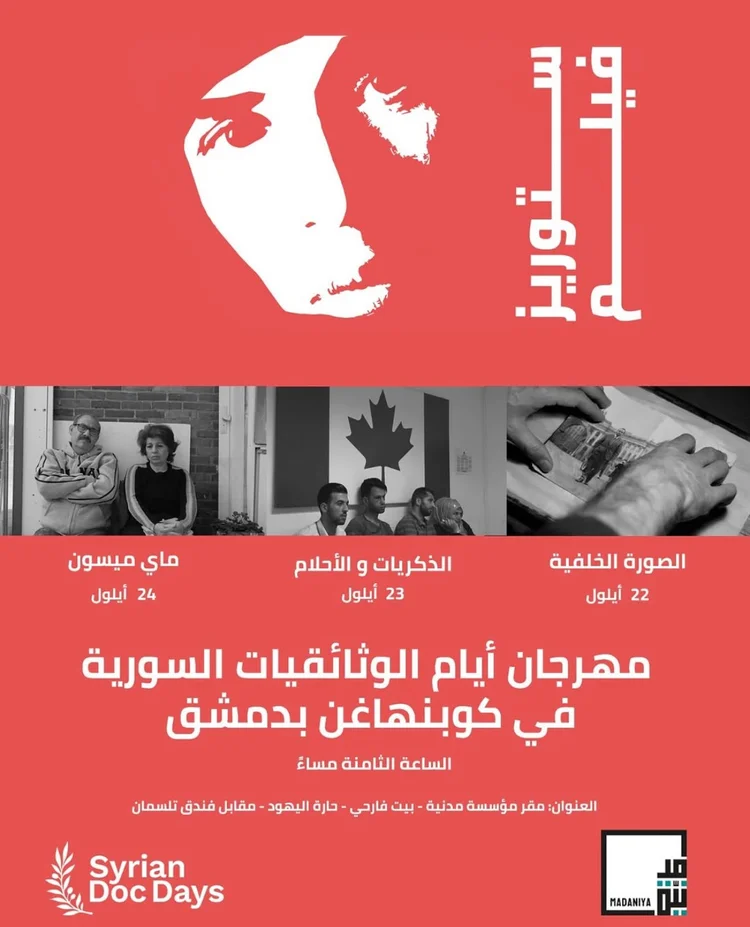
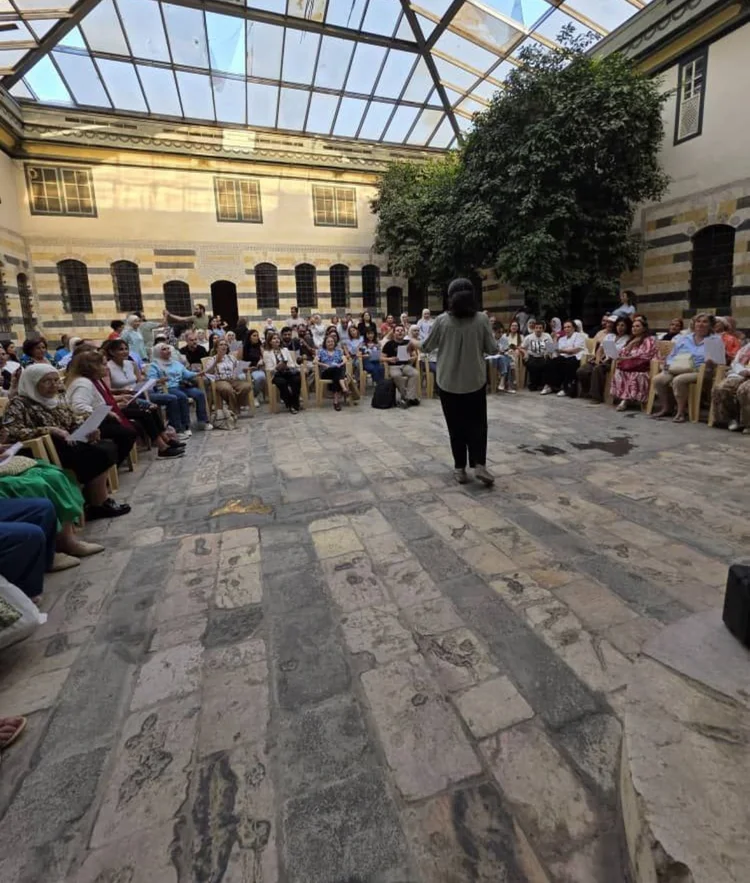
Syrian Documentary Days Festival In collaboration between the Copenhagen Syrian Film Festival and Stories Film Foundation, Madaniya’s headquarters hosted the Syrian Documentary Days Festival from 22 to 24 September 2025. These screenings formed part of a parallel programme organised in Damascus, held simultaneously with the main festival edition in Denmark, with the aim of connecting Syrian audiences inside the country to the latest documentary productions that reflect Syrian experiences and raise their questions. The films featured in this edition were: The Backdrop by Khaled Abdelwahed, Memories and Dreams by Ismail, and My Maison by Batoul Karbijah. The screenings provided a space for dialogue with the filmmakers and contributed to enriching conversations about independent Syrian cinema and its role in documenting memory and questioning reality. Songs Are Still Possible On 27 September, Gardenia Choir organised a community arts event entitled Songs Are Still Possible at Madaniya’s headquarters. The event featured an open collective singing session with the participation of Syrians from diverse backgrounds. The initiative aims to promote a culture of collective music-making, emphasise the power of art to break social barriers, and foster a sense of belonging and peace amidst the complex circumstances Syrians continue to face.
|
In this section, we highlight the latest reports and updates issued by Syrian institutions or concerning Syria during the past month.
|
Confronting Assad’s Legacy: Justice and Transition in Syria after the Fall of the Regime The Syrian Legal Development Programme published an analytical report entitled Confronting Assad’s Legacy: Justice and Transition in Syria after the Fall of the Regime. The report provides an in-depth reading of the transformations underway in the country following the collapse of the Assad regime, focusing on the human rights, political, and institutional challenges hindering the establishment of a just and inclusive transitional path. The report highlights the persistence of old patterns of violations under new forms, including arbitrary detention, enforced disappearance, abuses against journalists and activists, as well as structural corruption within state institutions, weak judicial accountability, and the continued marginalisation and exclusion in public governance. It shows how the absence of institutional reform and the dominance of security-driven approaches risk reproducing the same grievances that prevailed under the former regime. It also examines the responsibilities of the transitional authority in charting a different course—one that dismantles the legacy of the security state, upholds the rule of law, ensures non-recurrence of crimes and violations, and creates genuine civic spaces that rebuild trust between citizens and the state. The report stresses that transitional justice should not be confined to judicial accountability alone, but must encompass comprehensive reforms across the security, judicial, and economic sectors, implemented transparently and rooted in the principles of participation and accountability. The report further presents a critical perspective on international justice mechanisms, warning that reducing justice to trials alone may fail to meet Syrians’ aspirations unless embedded within an integrated political framework that addresses the roots of repression, restores dignity to victims, and launches a national process of truth and redress. To read the full report, follow the link provided.
|
Parliamentary Elections in Syria: Between the Right to Representation and Political Risks Musawa published an analytical report entitled Parliamentary Elections in Syria: Between the Right to Representation and Political Risks. The report explores the complex context surrounding the organisation of parliamentary elections in Syria during the transitional phase, highlighting the legal, political, and social challenges to launching elections before the completion of transitional justice, institutional, and constitutional reforms. The report focuses on the risks of reproducing authoritarian elites and networks linked to the former regime if a safe, neutral, and inclusive environment is not guaranteed—one that enables the participation of all segments of Syrian society, including women, survivors of violations, and historically marginalised communities. It also raises concerns about political haste in holding elections as a marker of “stability,” without ensuring genuine guarantees for a democratic political process. The report further examines the temporary constitutional and legal frameworks that may be adopted during the transitional phase and proposes a set of principles and reform pathways that place the right to political representation, the restoration of trust in the electoral process, and corrective justice at the heart of any future electoral mechanism. To read the full report, follow the link provided.
|
The Right of Families of the Missing on Migration Routes — A Legal Report by the Syrian Centre for Media and Freedom of Expression The Syrian Centre for Media and Freedom of Expression published a legal and analytical report entitled “The Right of Families of the Missing on Migration Routes: Between International Law Standards and the Demands of Justice.” The report addresses one of the most neglected aspects of the Syrian forced migration crisis: the right of families whose relatives went missing while attempting to reach safety to know their fate and to hold the responsible parties accountable for the causes and circumstances of their disappearance. Drawing on an in-depth analysis of a range of international legal frameworks—from international humanitarian law and international human rights law to binding customary rules—the report demonstrates that the disappearance of individuals on migration routes is not only a humanitarian tragedy, but also a systematic violation of the right to life, the right to dignity, and the right to truth. This creates clear legal obligations for states and their security and border authorities. The report presents a number of documented cases that illustrate the scale of this issue, while also reviewing institutional failures in ensuring adequate investigations, mechanisms of redress, access to records, identification procedures, and families’ right to information and justice. It stresses that addressing the plight of the missing on migration routes cannot be limited to humanitarian or psychosocial support, but must be embedded within transitional justice frameworks and prioritised within national and international policies on asylum, accountability, and institutional reform. To read the full report, follow the link provided.
|
Suffering Behind Walls: Voices from Inside Syrian Detention Centres Sanabel Al-Furat released a research report entitled “Suffering Behind Walls: Voices from Inside Syrian Detention Centres,” which sheds light on the situation of detainees in facilities run by the Syrian authorities after the fall of the regime. The report draws on first-hand testimonies and in-depth interviews with survivors as well as relatives of detainees whose fate remains unknown. The report addresses the lasting psychological and social impact of detention on individuals, families, and communities, highlighting the lack of transparency, the persistence of violations, and the difficulty of accessing justice even during the transitional phase. It shows how practices of detention—whether in their conditions or motives—continue to bear the hallmarks of the former regime, marked by systematic repression, absence of oversight, and the abuse of power. It underscores the urgent need for judicial and security sector reform as an integral part of transitional justice, stressing the importance of providing psychological, social, and legal support to survivors, and ensuring their meaningful participation in shaping justice and accountability policies. The report also calls for the launch of a national process to document violations inside detention centres and link them to mechanisms of accountability and reparation, within an approach that guarantees non-repetition and safeguards the dignity of all those subjected to torture, enforced disappearance, or arbitrary detention. To read the full report, follow the link provided.
|
|
| |

Comments