|
$$PLAIN_TEXT_PREVIEW$$
Madaniya’s Monthly Newsletter
|
Dear colleagues, representatives of civil society organisations, and members of the press We hope you have had a productive month! Below is our newsletter for the month of September, where we share the latest developments in Madaniya and the Syrian civic space with you. Our best wishes, Madaniya’s Team
|
Advancing National Dialogue on the Political Process in Syria in Accordance with UNSC Resolution 2254 In the past few months, we have shared regular updates regarding the project aimed at advancing the national dialogue on the political process in Syria, particularly the first round of dialogues that included 13 workshops held in Sweida, Damascus, Rural Damascus, Hama, Latakia, Idlib, Azaz, Deir ez-Zor, Qamishli, and Raqqa, in addition to three virtual workshops involving civic actors from neighbouring countries and the diaspora. We also informed you of the initiation of the research team and steering committee’s work to compile the outcomes of these workshops and prepare a comprehensive report. This report aims to facilitate a smooth transition to the second phase of the project, which seeks to organise internal Syrian dialogues that transcend geographical and local boundaries. Here are key excerpts from each workshop: On the Political Process:
The issue of fair political representation dominated the discussions. Participants pointed out the shortcomings of Resolution 2254, explaining that the political weakness stems from the failure of both political and civic entities to build inclusive community bases and adopt policies that create spaces for national dialogue that transcends geographical divisions.
On the Transitional Governing Body:
Participants expressed that the ambiguity of Resolution 2254 regarding the structure and mandates of the Transitional Governing Body weakens the chances of its formation and the establishment of national consensus around it. This leaves its details open to interpretation and subject to regional and international polarisation. Despite these challenges, the discussions emphasised the importance of continuing to demand the establishment of a Transitional Governing Body in accordance with Resolution 2254 and proposed four scenarios for its formation.
On Constitutional Reform:
Participants showed frustration with constitutional discussions due to their failure to make any progress in the Geneva negotiations, where the political process has been reduced to constitutional talks that have not achieved any political breakthroughs to support the democratic transition. Nevertheless, there were strong demands for comprehensive constitutional reform, as it is considered a necessary condition for achieving the political transition outlined in Resolution 2254.
On Electoral Reform:
The discussions unanimously agreed that any future transitional elections in Syria—whether local, legislative, or presidential—will not meet standards of fairness and transparency if they continue under the current constitutional and electoral framework. Recommendations were made to improve electoral systems in areas outside regime control, as well as for future elections on a national level.
|
|
One of the main projects that Madaniya has worked on this year is the Syria Strategy project, in collaboration with the Atlantic Council, the Middle East Institute, and the European Institute of Peace. The project progresses along two main tracks: working with experts and working with diplomats specialised in the Syrian file. Madaniya organised a meeting between member organisations and the project director at the Atlantic Council, where the key ideas being discussed by the working groups at this stage were reviewed. In the justice and accountability axis, the focus was on the need to determine the fate of the forcibly disappeared and detained individuals, emphasising that criminal accountability is important but is not the only path to achieving justice, and that steps must be measurable and irreversible. In economic development, discussions stressed the need for transparent financial mechanisms to facilitate the flow of funds into Syria, with a focus on cooperation with non-governmental entities to improve living conditions and prioritise crossline mechanisms to strengthen national unity. Regarding governance, the focus was on empowering independent civic institutions, reforming government structures, and investing in education and capacity building, while supporting transparency and oversight to ensure sustainable governance. In the humanitarian aid axis, emphasis was placed on localising aid and relying on local entities for early recovery, considering governance, and increasing support for refugees in neighbouring countries to avoid instability. For the political transition, the discussions called for changing the dynamics of power on the ground to ensure the effectiveness of the UN-led political process, with an emphasis on exploring how to implement UN Security Council Resolution 2254 and avoiding full reliance on the Syrian regime’s approval. Regarding security and security sector reform, the importance of empowering local actors to achieve stability was highlighted, alongside the need for a comprehensive strategy to combat terrorism and address the roots of the Syrian crisis.
|
The Annual Syrian Conference, 2024 Throughout this year, in coordination with several partners from Syrian civil society organisations, we have worked on developing a new initiative to organise an annual Syria conference that brings together a wide range of Syrian civic actors. This conference will focus on discussing key issues related to Syria, including humanitarian and political dimensions, as well as accountability and human rights. The aim of the conference is to bring together civil society actors from inside Syria, neighbouring countries, and the diaspora, in coordination with a group of Syrian political entities. The conference will also include regional and international diplomats responsible for the Syrian file, as well as officials from the foreign ministries of countries involved in the Syrian file. These annual conferences will become a recurring event designed to adapt to the evolving challenges facing Syria, their regional implications, and ways to address them. The conferences will focus on amplifying the voices of Syrian civil society, coordinating with political actors, addressing the stagnation in political and technical files, and engaging with international and regional stakeholders. Additionally, the conference will be positioned to become an ongoing event led and owned by Syrians, equal to the international annual conferences that discuss the situation in Syria. These conferences will be organised by a group of Syrian organisations in coordination with Madaniya, providing technical, financial, and logistical support based on each organisation’s capacities. At this stage, the organisational committee for this year’s conference has been finalised. It includes Madaniya, the Local Councils Unit (LACU), Bahar Organisation, Baytna, and the Syrian Civil Defence (White Helmets), along with other Syrian organisations that will partner in designing and planning the conference programme. Given that the conference will be held annually, the committee will be restructured on a yearly basis to reflect the interests and capacities of participating organisations, ensuring that the organisations forming the committee are committed to a political solution based on principles and human rights regarding the Syrian crisis. The committee will work collaboratively to prepare the agenda and organise the event, ensuring broad participation from various entities aligned with the values and goals of the conference. This year’s Syria Conference will be held in Brussels, Belgium, over three days during the last week of November.
|
Madaniya’s Engagements with ongoing Events
|
Position Paper and High-Level Meetings on Recent Political Developments and the Escalating Violence Against Refugees.In response to the escalating regional rapprochement efforts with the Assad regime and the increasing violations against Syrian refugees, particularly in Lebanon and Türkiye, as well as the letter and non-paper presented by eight EU member states urging European Commission Vice-President Josep Borrell to reassess the EU’s policies toward Syria, Madaniya organised a press conference in collaboration with the Syria Campaign, Baytna, the Syrian Centre for Media and Freedom of Expression, and the Syrian Civil Society Networks Platform, along with other civil society organisations. The event was held in Brussels on 12 September 2024. The goal of the conference was to address the rising violence against Syrian refugees and the risks posed by current diplomatic approaches that could strengthen the Assad regime and maintain the status quo without addressing the humanitarian, political, and human rights challenges in Syria. Before the conference, Madaniya and the organising committee shared a position paper with international and regional actors, including the European External Action Service, France, Germany, the Netherlands, Austria, Italy, Greece, Turkey, the United Kingdom, the United States, and the UN Special Envoy’s Office for Syria. This paper outlined the potential risks of rapprochement with Assad and how it could undermine international law, human rights principles, and peacebuilding efforts. Based on this paper, Madaniya representatives and the organising committee held a series of meetings with international and regional actors involved in the Syrian file. These discussions aimed to explore ways to address the political deadlock, human rights challenges, and broader humanitarian crises in Syria, with a focus on concerns about normalisation, refugee safety and voluntary return, and the politicised early recovery efforts.
|
|
Summary of the Position Paper The paper presented the Syrian rejection of normalisation with the Assad regime, responding urgently to the regional and international efforts aimed at rapprochement. It emphasised the risks of this approach, noting the need for international efforts to adhere to UN Security Council Resolution 2254 as the only framework for achieving peace in Syria. The paper highlighted concerns that current rapprochement efforts could obstruct the political process, threaten long-term peace and security in Syria and the region, exacerbate the refugee crisis, and perpetuate impunity for war crimes. It called for respect for the Syrian people's demands for a political solution that upholds their rights. The paper also warned that the current diplomatic efforts could reinforce the regime’s power, deepen the country’s division, and increase regional instability due to foreign interventions. It stressed the need to implement UNSC Resolution 2254 to ensure the rights of Syrians and end the conflict.
|
|
Summary of Meetings with International Stakeholders Ahead of the press conference, Madaniya and the organising committee held urgent meetings with several European bodies, including the European External Action Service (EEAS), the European Neighbourhood Policy and Enlargement Negotiations (DG NEAR), the European Civil Protection and Humanitarian Aid Operations (DG ECHO), the European Commission Service for Foreign Policy Instruments (FPI), and selected EU member states such as Italy and France. Additionally, there were meetings with the UN Special Envoy’s Office for Syria, the UK, and the US. These discussions addressed the political challenges, human rights, and humanitarian crises in Syria. During the EU meeting, the focus was on how to respond to the letter submitted by the eight states ahead of the EU meeting on 13 September. The Syrian delegation discussed with the EU the need for a more proactive strategy towards Syria, ensuring that EU policies support a political solution that improves the humanitarian situation without compromising accountability. The meeting with the UN Special Envoy’s Office highlighted concerns about the political exploitation of the refugee crisis, stressing the importance of protecting civilians and human rights within the political process in line with UNSC Resolution 2254. Meetings with the UK and US centred on refugee protection and preventing forced returns, as well as the risks of politicising early recovery efforts. The delegation emphasised the need for international and regional coordination to protect refugees and ensure that recovery efforts are not used to rehabilitate the Syrian regime.
|
|
|
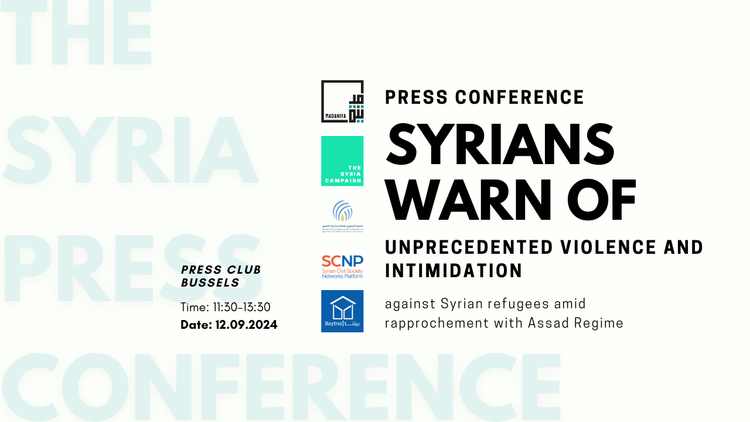
Press Conference in Brussels As part of the broader initiative on recent political developments and the escalating violence against refugees, a press conference was held on 12 September 2024 at the Press Club in Brussels. The conference responded to the growing efforts at rapprochement and the increasing violence and intimidation against Syrian refugees. During the conference, Syrian civic actors issued a clear warning about the rising risks posed by ongoing rapprochement efforts with the Assad regime, warning that these efforts could endanger refugees further and weaken international efforts to resolve the Syrian conflict sustainably. The press statement urged international policymakers to address the root causes of the conflict in Syria, including the regime’s repressive practices, rather than relying on containment strategies that focus solely on increasing aid without addressing security and political issues. It was emphasised that diplomatic efforts must not falsely portray Syria as safe for refugees. The ongoing violence, intimidation, and forced deportations of Syrian refugees in neighbouring countries and Europe were highlighted as direct consequences of the narrative attempting to frame normalisation as a step toward peace. A wide range of local and international media outlets attended the press conference, along with representatives from several Special Envoys to Syria, including those from the UK and France, as well as other relevant regional and international political actors, including representatives from the Syrian Negotiation Committee. To read the meeting summaries and more about the press conference and position paper, visit the available link. |
|
|
|
Updates on the Work of Member Organisations
|
In this section, we review the achievements and developments in the work of Madaniya's member organisations.
|
|
10th Anniversary of the White Helmets On 25 October 2024, the Syrian Civil Defence (White Helmets) celebrates its 10th anniversary. This significant milestone reminds us of the principles charter initially signed by around 70 team leaders from across Syria. Over the past decade, the Civil Defence teams have faced numerous challenges, from losses and displacement to heroic rescue missions. Despite these difficulties, the organisation has successfully built a national front of more than 3,000 volunteers who work tirelessly to save lives and strengthen community resilience. We would like to invite you to join the White Helmets in this special celebration and support their volunteers through the following ways: Write a Letter to the Volunteers: You can write a handwritten letter addressed to any volunteer you know or to all volunteers in general. Take a picture of your letter and send it to us by 18 October, and we will share it with the White Helmets team, who will then distribute it to the field teams.
Engage on Social Media: Share your messages or any supportive content using the hashtag #WhiteHelmets10 on 25 October or during the same week. You can follow the White Helmets’ social media accounts listed below.
If you would like to organise additional activities or events for this occasion, please let us know, and we will provide direct communication with the team. We look forward to your participation and support for this important occasion. White Helmets Social Media: |
|

|
|
|
|
In this section, we highlight the latest reports and updates issued by Syrian organisations or about Syria during the month.
|
Improving the Effectiveness of Sanctions: How the Syrian Regime Controls the Economy The Syrian Legal Development Programme shared a report titled Improving the Effectiveness of Sanctions: How the Syrian Regime Controls the Economy, which explores the role and effectiveness of sanctions imposed on Syria, given the regime’s control over the economy. The report highlights that despite individual and sectoral sanctions, the Syrian regime continues to maintain control over economic institutions and the private sector, diminishing the effectiveness of these sanctions and exacerbating the suffering of ordinary citizens. The study reveals that sectoral sanctions on Syria’s economy struggle to achieve their goals due to the regime’s dominance over profitable sectors such as oil, telecommunications, and even basic foodstuffs like wheat and sugar. This control allows the regime to enact laws and regulations that favour its close circles and further exploit the private sector for the benefit of the elite tied to the regime. The report also notes that the regime uses coercive state tools such as tax imposition, asset freezes, and the threat of arrest to force companies into compliance. Moreover, the regime relies on manipulating business interests to bolster its wealth and political influence, complicating the sanctions landscape and limiting their impact. The report recommends that sanctioning countries adopt a clear and effective strategy to achieve specific objectives, maintaining sectoral sanctions while clarifying what outcomes should be pursued. It also emphasises the importance of strengthening individual sanctions against key regime-affiliated capital holders and providing support to small businesses and local initiatives that contribute to improving the local economy, independent of the regime-linked elite. To read the full report, visit the provided link.
|
| | |

Comments