|
$$PLAIN_TEXT_PREVIEW$$
Madaniya’s Monthly Newsletter
|
Dear colleagues and representatives of civil society organisations, We hope you are doing well. The rapid developments in Aleppo and Idlib over the past few days have highlighted the fragility of the situation in Syria and the failure of policies aimed at containing the stalemated conflict and managing it through a de facto approach. In light of these developments, accompanied by the regime and its allies’ airstrikes on vital infrastructure and the potential for severe military escalation across the region, Madaniya believes that the balance of power has shifted. This underscores the urgent need to revitalise the political process in accordance with Resolution 2254, addressing all its components rather than limiting efforts to the ineffective constitutional track. At Madaniya, we reaffirm our pivotal role as civic actors during this critical phase. We are committed to employing all possible means to protect civilians and civil infrastructure, document violations committed by all parties, and create the necessary conditions to empower the civil administration in areas now under control. This includes ensuring their independence by activating state institutions operating within these areas and involving local cadres from the community at both political and service levels. Below is our newsletter for November, where we share the latest updates from Madaniya and the Syrian civil space. With warm regards,
The Madaniya Team
|
Updates on Madaniya’s Work
|
Madaniya Board Elections 2024 The Supervising Committee for the 2024 Madaniya Board of Directors elections continues its work in accordance with the provisions of Madaniya’s Bylaws and electoral regulations. Over the past weeks, the committee has been developing criteria and procedures to launch the electoral process. This has included opening nominations for ten seats on the Madaniya Board of Directors for its first electoral term and reviewing the electoral register of organisations wishing to participate. Currently, the committee is evaluating the list of candidates across the five electoral districts to share it with the member organisations on the electoral register, allowing for objections to be submitted within a specified timeframe, which will be announced by the committee. We hope that these elections mark an important step towards strengthening our collective civic action and establishing a robust administrative structure that reflects the aspirations of Madaniya’s members and contributes to achieving its shared goals. |
|

|
|
The Annual Syria Conference 2024 In light of the significant developments in the region, ranging from the war in Lebanon and its repercussions on Syria to the ongoing escalations in Aleppo, the Conference Organising Committee has decided to postpone the conference to next year. The exact date will be announced at a later time. This postponement aims to allow sufficient time to secure the necessary logistical support for all participants, particular for facilitating visa issuance for colleagues travelling from within Syria and neighbouring countries. Additionally, we seek to enhance the conference programme to better reflect the regional and local developments and their implications for various issues concerning Syria. We will provide you with the new dates and all related updates in the near future.
|
Madaniya's Interactions with Ongoing Events
|
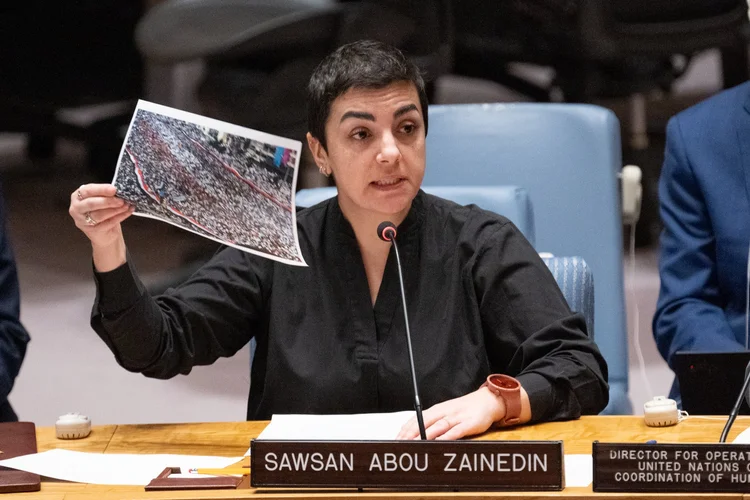
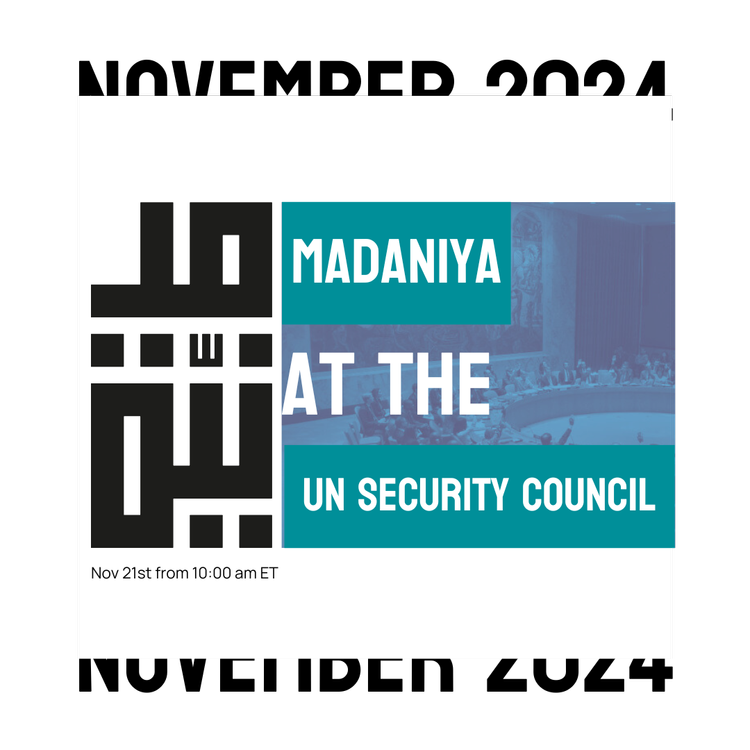
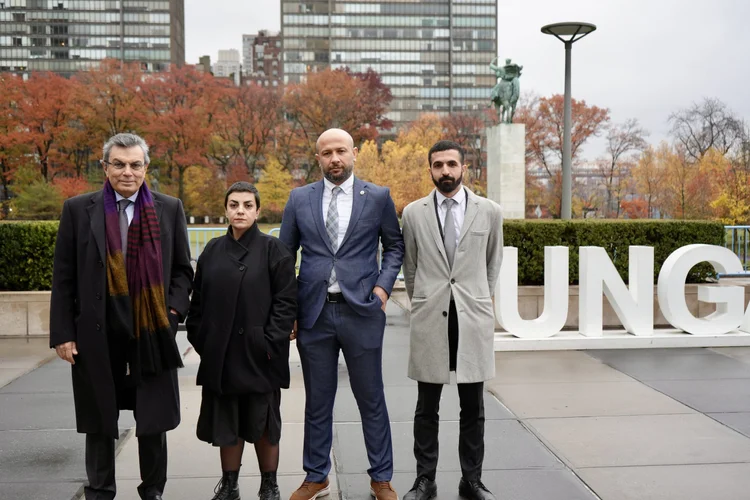
Madaniya at the United Nations Security Council On 21 November 2024, upon an invitation from the United Kingdom, Madaniya, represented by its Chief Executive Officer, delivered a briefing at the Security Council’s formal session on the situation in the Middle East and Syria. The briefing addressed the ongoing Syrian conflict, now in its thirteenth year, shedding light on the Syrian people’s enduring struggle for freedom, dignity, and justice. It highlighted Syrians’ substantial efforts towards justice and accountability, such as the establishment of the International, Impartial, and Independent Mechanism (IIIM), the Independent Institution on Missing Persons, the prosecution of war criminals under universal jurisdiction, and the issuance of international arrest warrants against Bashar al-Assad and others. The briefing also focused on the politicisation of humanitarian aid, criticising the United Nations’ failure to deliver aid following the 2023 earthquakes due to political considerations and the subsequent obstruction of cross-border aid, and underscoring how the Syrian regime exploits aid as a tool to consolidate its control over the country. The briefing highlighted the deadlock in the political process in accordance with Security Council Resolution 2254, criticising the international community’s inability to advance a political solution. It emphasised that the politicisation of all aspects of the conflict, including aid and accountability, has bolstered the regime’s authority while marginalising the Syrian people’s rights. Through the intervention, Madaniya called for leveraging every possible avenue, including technical issues like aid and justice, as pressure points to activate the political process and compel the regime to make irreversible concessions leading to genuine political progress. The briefing concluded by stressing the need to rebuild Syria on fair democratic foundations, supporting Syrian civil society and ensuring the voluntary, safe, and dignified return of refugees. Madaniya underscored that any political settlement ignoring the rights and dignity of the Syrian people is doomed to fail, as the Syrian people remain resolute in reclaiming their state founded on citizenship, democracy, and justice. For the full details of the briefing, visit the provided link.
|
The Second International Conference on Syrian Civil Society and Chemical Weapons On 22 November 2024, the Second International Conference on Syrian Civil Society and Chemical Weapons was held, delivering a strong and unified call for justice and accountability for the use of chemical weapons in Syria. Madaniya, alongside Syrian civil society organisations such as the White Helmets, Baytna, the Syrian Center for Media and Freedom of Expression, the Don’t Suffocate the Truth campaign, the Syrian Legal Development Program, the Syrian American Medical Society, and the Syrian Civil Society Networks Platform, co-organised the conference. This year’s conference, titled “Eleven Years of Impunity: Tremendous Efforts, Slow Progress Towards Accountability”, took place amidst declining political and humanitarian attention to the Syrian issue due to escalating regional and international tensions. The conference addressed the ongoing challenges in achieving justice for victims of chemical weapons use in Syria, highlighting the essential role of accountability in preventing the recurrence of such atrocities. Despite Syria’s membership in the Chemical Weapons Convention since 2013, more than 168 chemical attacks have been documented, with justice remaining elusive. Over the years, national and international actors have made significant efforts to build the capacity of emergency response teams, document evidence, and support accountability initiatives. However, the continued use of chemical weapons without consequence undermines international law and jeopardises prospects for sustainable peace in the region. Nevertheless, the conference stood as a testament to the resilience of Syrians in building institutions that serve their communities and pursue justice through Syrian-led efforts for their society. The organising committee presented a joint statement, signed by Syrian civil society organisations, to the member states of the Organisation for the Prohibition of Chemical Weapons. The statement called for prioritising Syria’s non-compliance with the Chemical Weapons Convention, countering disinformation campaigns that harm victims, enforcing international arrest warrants, and supporting new avenues for achieving accountability. For the full statement, visit the provided link.
|
Madaniya’s Meeting with EU Mashreq/Maghreb Member States In continuation to a series of meetings with international and regional actors, Madaniya participated in a meeting with representatives of EU member states in the Mashreq/Maghreb Group on 19 November 2024. This engagement aimed to address the increasing regional rapprochement with the Assad regime and the growing violations against Syrian refugees, particularly in Lebanon and Turkey. The meeting followed a joint letter and non-paper submitted by eight EU member states, urging European Commission Vice President Josep Borrell to reassess EU policies on Syria. During the meeting, Madaniya, accompanied by representatives from Baytna, the White Helmets, and The Day After, delivered comprehensive briefings. The discussions centred on mechanisms to revitalise the political process within the framework of UN Security Council Resolution 2254. Participants also explored ways to address the refugee issue, particularly in light of forced displacements from Lebanon to Syria caused by Israeli attacks, ensuring that any efforts prioritise the conditions for a safe, voluntary, and dignified return. Additionally, the discussion included the topic of early recovery efforts, underscoring the importance of implementing monitoring mechanisms based on human rights-based conditionality. The meeting also provided an opportunity to examine key challenges and potential opportunities related to these critical issues. Clear recommendations were presented, aimed at reinforcing international commitments to the fundamental rights of Syrians and advancing the political resolution process. The session concluded with an emphasis on the necessity of sustained dialogue with EU member states and a commitment to organising further engagements with other international and regional groups in the near future.
|
Madaniya at the Twentieth Meeting of the Core Donor Group on the Syrian Crisis On 26 November 2024, Madaniya participated in the twentieth annual meeting of the Core Donor Group on the Syrian Crisis, organised by the European Union. This gathering brought together key donors from the EU and its member states, along with Canada, the United States, the United Kingdom, Japan, and Gulf Cooperation Council countries, as well as UN agencies and various support funds operating in Syria. The focus of this year’s meeting was early recovery efforts beyond the framework of humanitarian aid, with particular emphasis on two main topics: supporting the private sector and addressing refugee and return issues through the lens of housing, land, property rights, and civil documentation. Madaniya’s intervention centred on the challenges surrounding refugees and their return, specifically regarding access to housing, land, property rights, and civil documentation. It highlighted the systematic politicisation of these issues, which has deliberately obstructed and complicated the return of displaced individuals. Madaniya presented key recommendations to address these deep-seated challenges, particularly the steps required from the Syrian regime to depoliticise this file. These measures included eliminating security clearance requirements, recognising property transactions and documents issued in areas outside the regime’s control, repealing post-2011 laws that have violated property rights—such as those tied to counterterrorism and mandatory military service—and allowing independent organisations to provide legal aid. This would counter the monopoly of regime-affiliated entities like the Syria Trust for Development. At the international level, Madaniya called for an approach grounded in the right to housing, framed within an inclusive, victim-centred perspective. It emphasised the need for principled and rights-based planning, ensuring equitable access across all communities, and conducting comprehensive risk assessments to avoid complicity in further violations. Madaniya also stressed the importance of addressing these issues with a long-term vision that safeguards justice and equity for all affected Syrians.
|
Updates from Madaniya’s Member Organisations
|
In this section, we highlight the achievements and developments in the work of Madaniya's member organisations.
|
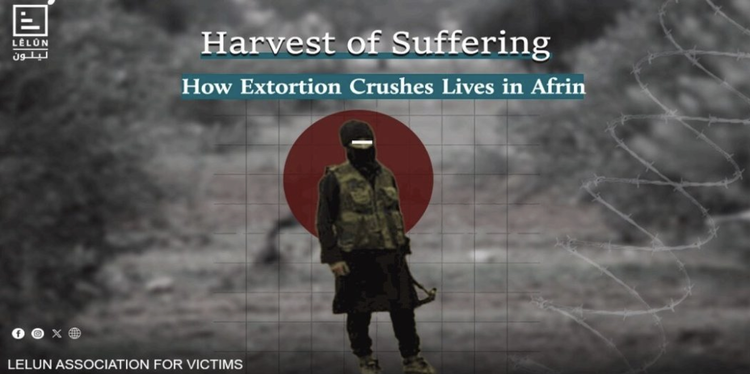
Harvest of Suffering: How Extortion Crushes Lives in Afrin– A Report by Lelun Afrin Organisation The recent report shared by Lelun Afrin Organisation, sheds a light on the violations endured by residents of Afrin, one of Syria’s key olive-producing regions. Since the takeover by factions of the "Syrian National Army" in 2018, local residents and farmers have faced widespread campaigns of extortion and arrests, exacerbating their suffering and threatening their livelihoods. The report documents practices including preventing residents from harvesting olives, imposing exorbitant levies on crops, and seizing the property of expatriates or displaced individuals. It also details incidents of physical assault against civilians unable to pay the demanded sums, alongside theft and destruction of harvests. Testimonies reveal those certain factions, such as "Al-Hamzat" and "Sultan Suleiman Shah – Al-Amshat," exploit their positions of power to exert control over the population, even forcing residents to use specific olive presses under threat of punishment. The report highlights a systematic policy of extortion imposed on residents, with levies ranging from $2 to $30 per olive tree and up to 50% of expatriates’ harvests. This has driven some residents to sell their properties or flee to other areas. Women and children are particularly affected, with some women being coerced into relinquishing their rights to harvest land under direct threats. Legally, the report describes these violations as grave breaches of international humanitarian law, including the Fourth Geneva Convention, which prohibits collective punishment, inhumane treatment, and theft of property. It underscores Turkey's responsibility, as the de facto power in the region, to protect civilians and ensure compliance with international humanitarian law. The report calls for an independent international investigation into the documented violations, accountability for those responsible, and compensation for the victims’ material and moral losses. It also stresses the necessity of establishing effective monitoring mechanisms to prevent the recurrence of such abuses and holding Turkey accountable for fulfilling its legal obligations to safeguard civilians and uphold human rights. For the full report, visit the provided link. |
|
|
|
|
|
Combating Impunity for Crimes Against Journalists in Syria – A Report by the Syrian Center for Media and Freedom of Expression The Syrian Center for Media and Freedom of Expression has published a report addressing mechanisms to combat impunity for crimes and human rights violations committed against journalists in Syria. The report aims to shed light on the tragic reality faced by journalists and media workers in Syria due to systematic repression and crimes against them, while presenting national and international legal options and mechanisms to promote accountability and achieve justice. The report explores available avenues for holding perpetrators accountable for crimes against journalists, focusing on United Nations mechanisms such as the Human Rights Council and the Human Rights Committee, which provide channels for monitoring violations and demanding justice. It also examines the role of international judiciary bodies, including the International Criminal Court and independent international mechanisms investigating crimes committed in Syria. Additionally, it highlights the potential of universal jurisdiction, which enables the prosecution of serious crimes in national courts irrespective of where they occurred. On the national level, the report identifies weaknesses in the legal systems across Syria, whether under regime control, opposition governance, or self-administration. These systems often fail to protect journalists or prosecute offenders. The report underscores the critical role of civil society-led local efforts in advancing accountability and justice. The report offers several recommendations to enhance the legal protection of journalists and media workers, emphasising the need to repeal oppressive legislation used to suppress press freedom. It calls for support for national and international initiatives aimed at achieving justice and accountability, while ensuring the establishment of effective mechanisms to access information and protect journalists’ sources. Moreover, the report stresses the importance of involving Syrian civil society in efforts to secure justice. Overall, the report urges the international community and local and international institutions to take decisive steps to hold perpetrators accountable for crimes against journalists and to ensure a safe and independent environment for media work in Syria. It highlights that impunity poses a direct threat to human rights, justice, and the rule of law. For the full report, visit the provided link. |
|
|
|
In this section, we highlight the latest reports and updates released by Syrian organisations or about Syria during the month.
|
Lessons Learned from Displacement in Northwest Syria – A Policy Brief by the Women’s Advisory Group The Women’s Advisory Group has released a report outlining best practices drawn from the emergency humanitarian response to waves of displacement caused by military escalation in northwest Syria. The report is based on the experiences of women who actively participated in responding to the major displacement crises between 2019 and 2020. Its goal is to provide practical recommendations for decision-makers to avoid past mistakes and improve the quality of humanitarian interventions, ultimately reducing harm to displaced populations. The report underscores the importance of utilising locally available communication tools, such as radio devices, which prove effective in crisis situations where internet services are lacking. It also highlights the need to involve active members of affected communities, whose local knowledge enables them to conduct rapid and accurate assessments of displaced people's needs in arrival locations. It recommends collaboration with local leaders to ensure an effective response that complements the efforts of local communities. For instance, in Ruheen, community members successfully transformed a landfill into a shelter site for displaced people through voluntary efforts, facilitating subsequent humanitarian organisation efforts to expand and improve the site. The report also stresses the significance of meticulous resource documentation to avoid waste and ensure optimal use, citing the example of relocating medical equipment from Maarat al-Numan to alternative locations. The report calls for enhanced coordination between displaced local councils and host councils to avoid duplication of efforts and wastage of resources. It suggests clear signage along roads to facilitate the safe movement of displaced individuals and minimise risks. Additionally, it emphasises the importance of engaging local collectives, such as volunteer teams and teachers, and addressing their collective needs to ensure a well-organised and effective response. The report also advocates for the improvement of coordination systems, ensuring comprehensive access to information, and adherence to rights-based practices to achieve a sustainable and effective humanitarian response. The report concludes by stressing the necessity of community involvement to ensure that humanitarian efforts align with the actual needs of the displaced population. For the full report, please visit the provided link.
|
| | |

Comments