|
$$PLAIN_TEXT_PREVIEW$$
Madaniya’s Monthly Newsletter
|
Dear colleagues, representatives of civil society organisations, We hope this finds you in good health and spirits. Below is our November newsletter, where we share the latest updates from Madaniya and developments across the Syrian civic space. Best wishes,
Madaniya’s Team
|
Updates on Madaniya’s Work
|
|

|
The Political Transition Observatory Project Madaniya,
in partnership with The Day After, is concluding the first phase of the
Political Transition Observatory project, which aims to articulate
civil society’s vision for priority reforms during the transitional
period. This phase saw the completion of the majority of dialogue sessions, with a total of 75 sessions held across five main regions—the north, south, east, center, and coast—in addition to several virtual sessions that enabled broader participation. Work is currently underway to finalize the remaining complementary sessions, with discussions centered around six key themes: security sector reform, economic reform, constitutional reform, judicial reform, transitional justice, and elections. The
dialogue sessions within these six themes were designed to build a
shared vision that would inform the development of indicators
contributing to monitoring Syria’s political transition. With the conclusion of most sessions across the regions, the research team is now developing the initial framework of indicators,
which will be presented during the upcoming National Civil Conference.
This will pave the way for continued, participatory discussions with
local actors to finalize and adopt these indicators as a civil tool for tracking reform and transition processes. Madaniya is currently preparing for the National Civil Conference, scheduled for the second half of December 2025, during which the initial set of political transition indicators will be presented. Following the conference, dialogue sessions will continue in order to
develop the indicators into their final form through a participatory
approach, enabling their use as a civil monitoring instrument for the
reform process in Syria. We will soon share additional details regarding
the conference and participation modalities, as part of our ongoing
commitment to strengthening the role of civil society in shaping a
collective national vision for Syria’s future.
|
|
|
|
|
|
|
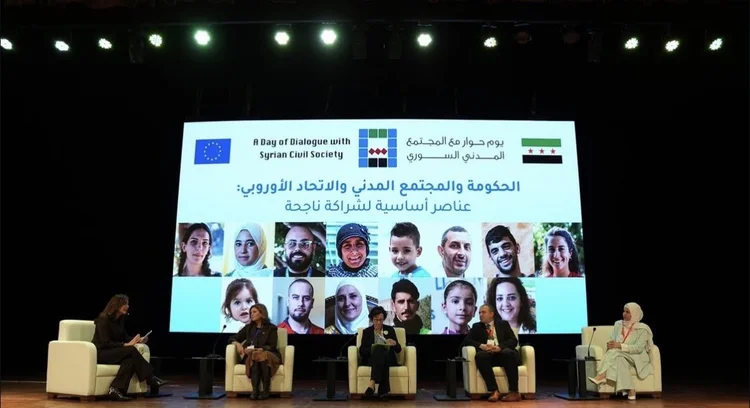
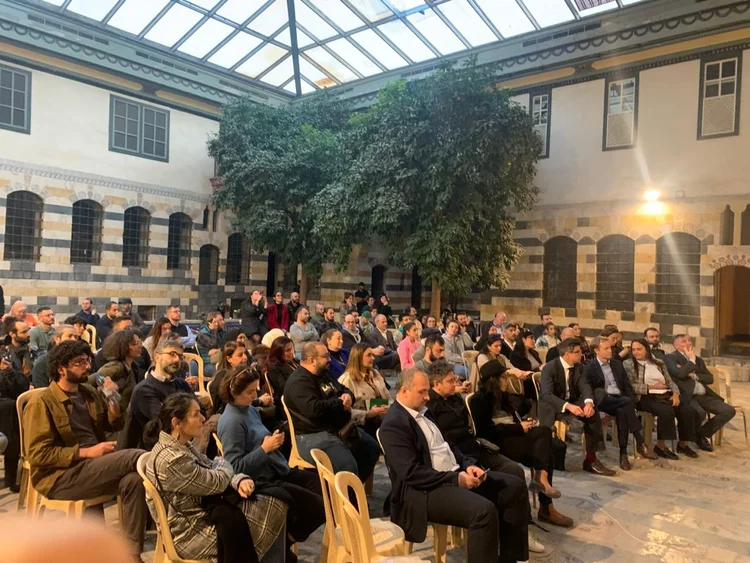
EU–Syria Day of Dialogue The EU–Syria Day of Dialogue was held on 15 November 2025, with the participation of Madaniya,
a wide range of Syrian civil society representatives, the European
Union, and the Syrian Transitional Government. This event marked the
first formal platform bringing together all three parties in a direct
discussion on the future of EU–Syria relations and priorities for the
transitional period. As part of its role on the steering committee, Madaniya worked alongside representatives of the European Union and the Syrian Ministries of Social Affairs and Labour and Foreign Affairs to oversee preparations for the event. In parallel, and jointly with the European Institute of Peace, Madaniya
facilitated a series of preparatory consultations held across several
Syrian regions in addition to virtual sessions, ensuring that the agenda
reflected the diversity of perspectives within Syrian civil society. |
|
|
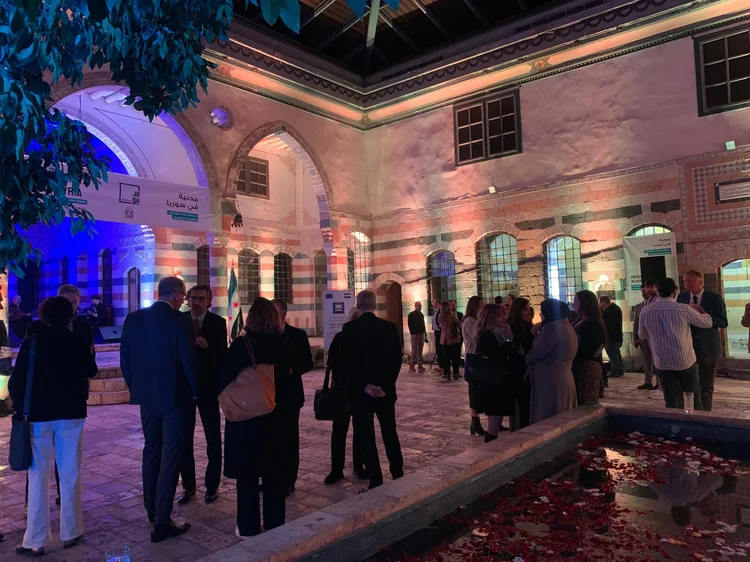
On the day preceding the dialogue, Madaniya hosted a reception at its headquarters in Damascus in partnership with the EU Delegation. The
gathering created an informal space for speakers, facilitators,
rapporteurs, as well as representatives of the Transitional Government
and the European Union, to connect and build common ground ahead of the
official sessions. During the Day of Dialogue, the sessions opened with official statements from the Transitional Government and the European Union, followed by an opening panel that brought together representatives of the government, the EU, and civil society, represented by Madaniya and the NGO Forum. In its intervention, Madaniya highlighted the historic role of Syrian civil society as a core partner in the country’s path to liberation and state-building — from the early peaceful movement to years of documentation, mobilisation, and community engagement. The intervention underscored that civil society’s contribution is rooted in a longstanding tradition of collective struggle. It also emphasised the need for Syrians to acknowledge the divisions that have marked the country, as well as the violations committed in various regions, including the coast and Suwayda, and stressed the importance of adopting a fair and transparent legal framework governing associations. Following the opening session, six thematic discussions were held in parallel, covering key areas including transitional justice, youth empowerment, protection of civic space, governance and political participation, social cohesion, and the shift from humanitarian response towards recovery and resilience. The day concluded with a closing session in which rapporteurs presented a synthesis of the main discussions from the various thematic sessions. |
|
|
|
|
Madaniya's Engagement with Ongoing Events
|
|

|
The United Nations Integrated Mission to Syria Madaniya, together with a coalition of Syrian civil society organisations,
continues its advocacy efforts aimed at reshaping the United Nations’
role in Syria to ensure that civil society’s perspectives are
meaningfully represented in ongoing UN discussions. This coalition
includes the Syrian Women’s Political Movement, the Syrian Center for
Media and Freedom of Expression, The Day After, the Syrian Legal
Development Programme, and several independent Syrian experts, working in coordination with Crisis Action. |
|
|
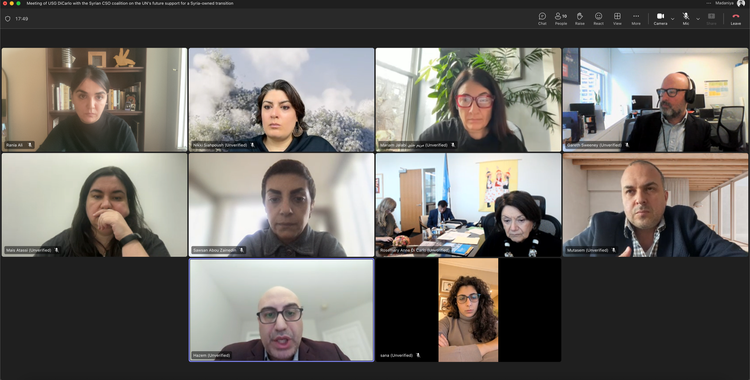
As part of this effort, and following an initial meeting with the Syrian Ministry of Foreign Affairs, Madaniya and its partners held a high-level meeting with Ambassador Rosemary DiCarlo, the UN Under-Secretary-General for Political and Peacebuilding Affairs. The meeting provided an opportunity to present civil society’s vision for a more inclusive and coherent UN approach that responds to the needs of Syrians and supports the current transition process. |
|
|
|

|
Madaniya and its partners are now preparing for a series of meetings with Syria’s UN Mission and a number of
UN Security Council member states, with the aim of advancing this track
and strengthening civil society’s presence in discussions concerning
the future of the UN’s role in Syria. Through these efforts, the civil
society coalition continues to work to ensure that Syrian civil
society’s priorities and aspirations for justice and stability are
embedded in any future UN arrangements related to Syria. |
|
|
|
Joint Workshop for Human Rights Defenders from Syria and Ukraine Madaniya,
in cooperation with the Ukrainian Public Interest Journalism Lab (PIJL)
and the Syrian Emergency Task Force, will host a joint workshop
bringing together leaders from Syrian and Ukrainian civil society,
alongside journalists, activists, and human rights defenders. The
workshop aims to facilitate the exchange of expertise, strengthen collaboration, and develop shared strategies for accountability, justice, and democratic resilience. The workshop will take place in person at Madaniya’s headquarters in Beit Farhi, Damascus, on Saturday, 6 December, from 2:00 to 5:00 p.m. It
will explore three key areas: addressing impunity by connecting the
Syrian and Ukrainian experiences; drawing on Ukraine’s extensive
documentation efforts and trauma-informed justice practices; and
examining future avenues for collaboration between the two civil
societies in advancing human rights, strengthening democratic
institutions, and building more resilient communities. The
list of Syrian speakers will be announced soon. From the Ukrainian
side, confirmed participants include several prominent figures: Oleksandra Matviichuk, Nobel Peace Prize laureate and head of the Center for Civil Liberties; Natalia Gumenyuk, journalist and co-founder of PIJL; Maksym Butkevych, a leading human rights defender and former detainee in Russian prisons; and Lenieie Umurova, a Crimean Tatar activist who spent two years in Russian captivity. To attend the workshop, please register through the available link.
|
Madaniya’s Meetings with International ActorsAs part of its ongoing efforts to strengthen dialogue and cooperation with international stakeholders engaged in the Syrian file, Madaniya continues to hold meetings with various international partners to discuss political and civic developments and explore avenues for supporting the priorities of Syrian civil society.
|
Meeting with the European Parliament’s Foreign Affairs Committee Madaniya, alongside several member organisations, participated
in a meeting with the European Parliament’s Foreign Affairs Committee
dedicated to discussing recent developments in the Syrian file and the
role of civil society in shaping a clear vision for European support and policy towards Syria. The meeting provided an opportunity to present the priorities of Syrian civil society regarding
the political process, the European Union’s role in supporting recovery
efforts, strengthening civic space, and upholding principles of justice
and human rights. It also served as a platform for member organisations
to share insights on the challenges facing civil society inside Syria
and in countries of asylum, as well as ways to enhance co-operation
between the European Parliament and Syrian civil actors.
|
Updates from member organisations
|
This section highlights the key achievements and recent developments in the work of Madaniya’s member organisations, along with events held at Madaniya’s headquarters in Damascus.
|
|
|
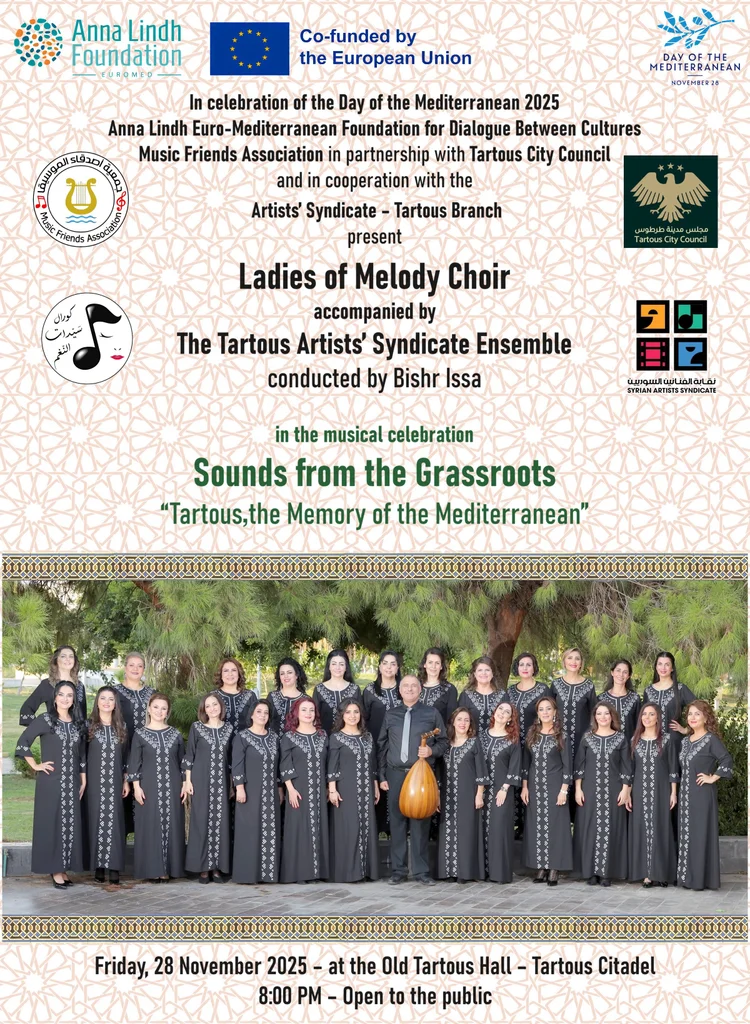
“Tartous, Memory of the Mediterranean” Celebration – Naghm Ladies’ Choir and the Friends of Music Association As part of the international programme for Mediterranean Day 2025, the city of Tartous hosted a special musical evening on 28 November, titled Tartous, Memory of the Mediterranean,
presented by the Friends of Music Association in partnership with the
Tartous City Council and in co-operation with the Artists’ Syndicate –
Tartous Branch, with the participation of the Naghm Ladies’ Choir. This event formed part of the wider international celebration organised by the Anna Lindh Euro-Mediterranean Foundation and funded by the European Union, honouring
the region’s shared cultural heritage and the historic role played by
Mediterranean cities in shaping the identity and memory of the wider
region. The evening featured a musical performance entitled Voices from the Roots – Tartous, Memory of the Mediterranean,
highlighting Syria’s vocal heritage and the enduring cultural
significance of Tartous as one of the Mediterranean’s historic coastal
cities. The Naghm
Ladies’ Choir performed a selection of pieces inspired by local
collective memory and coastal artistic traditions, accompanied by the
official musical ensemble of the city’s Artists’ Syndicate. |
|
|
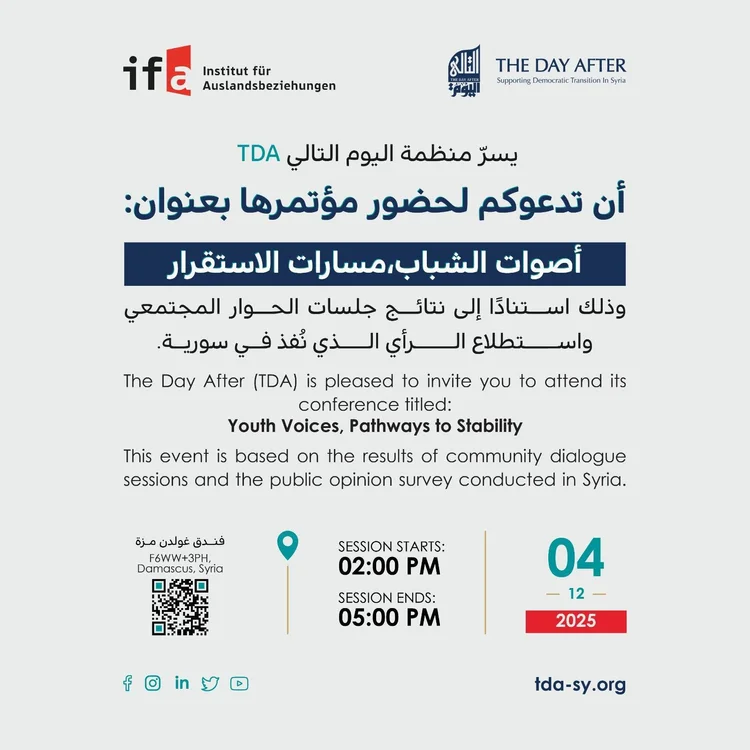
“Youth Voices, Pathways to Stability” Conference – The Day After On 4 December 2025, The Day After will hold a conference entitled Youth Voices, Pathways to Stability,
building on the cumulative findings of its community dialogue sessions
and a nationwide public opinion survey conducted inside Syria with the
participation of hundreds of young women and men from across the
country. The
conference aims to present a clear understanding of Syrian youth
priorities and their role in shaping pathways to stability in the coming
period. It will explore the key issues that emerged
during the dialogue sessions and highlight the trends revealed by the
survey, offering deeper insight into young people’s perspectives on the
political, social, and economic challenges they face. The event will take place in Damascus from 2:00 to 5:00 p.m.,
with the participation of civil society representatives, researchers,
and decision-makers. It will provide a space to examine how youth
engagement can be strengthened within efforts related to recovery, local
governance, and social justice, contributing to more sustainable
trajectories towards stability in Syria. |
|
|
|
|
“Convoy of Hope – A Roadmap to Sustainable Integration for Families Returning from Al-Hol Camp” – Stabilisation Support Unit On Sunday, 16 November 2025, the Stabilisation Support Unit held a dialogue session entitled “Convoy of Hope – A Roadmap to Sustainable Integration for Families Returning from Al-Hol Camp.” The session brought together partner organisations
and relevant stakeholders to discuss the challenges and opportunities
associated with the return of families from Al-Hol camp and the plans
for their community reintegration. The
discussion addressed lessons learned from the Unit’s recent evacuation
operations and the logistical and operational challenges that accompanied
them. The session also included a presentation of the Unit’s needs
assessment report, which examines the situation of returning families
and outlines the support required during the early stages of re-stabilisation.
Participants further explored partner roles and responsibilities,
followed mechanisms for monitoring and evaluation to ensure sustainable
interventions, and reviewed a set of practical recommendations to guide
future work. The session provided an important space for exchanging expertise and strengthening co-ordination among actors working on this file, within a broader effort to ensure more comprehensive and equitable approaches to meeting the needs of returning families and supporting their social and economic integration.
|
Events at Madaniya Headquarters – Damascus
|
Throughout November, Madaniya hosted a series of cultural, legal, and policy-focused events at its headquarters in Damascus, bringing together local organisations, international partners, and a wide range of civil society actors.
|
|
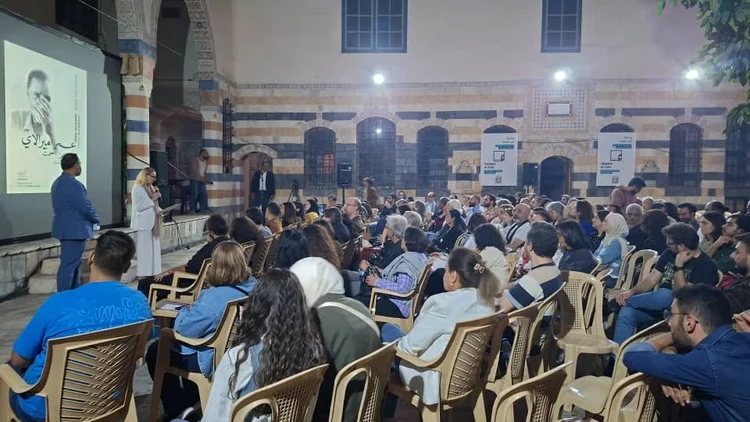
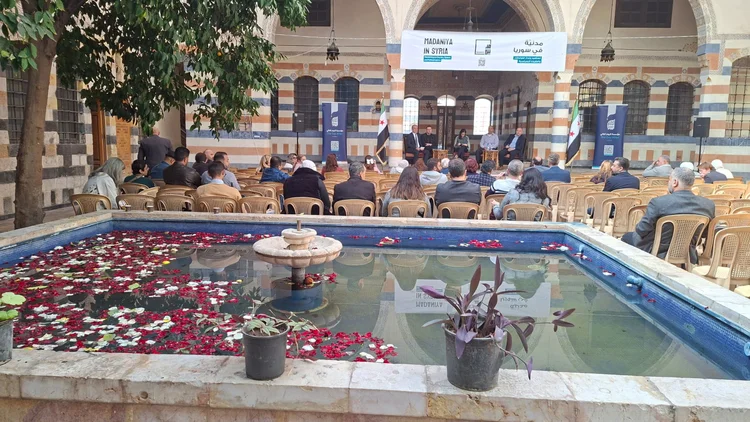
Archival Representation of Post-Assad Syria – Memory, Ethics, and Questions of Representation 29 November Madaniya hosted an event titled “Archival Representation of Post-Assad Syria: Memory, Ethics, and Questions of Representation,” organised by the collective Hajra Waraqa Maqass. The session explored artistic and documentary approaches to representing
Syria after political transition, the role of archives in preserving
collective memory, and the ethical challenges filmmakers and researchers
face when engaging with victim narratives and historical testimonies. Enhancing Women’s Political Participation and the Right to Pass Nationality – Musawat Organisation 29 November The organisation Musawat held a workshop at Madaniya’s headquarters entitled “Enhancing Women’s Political Participation and Their Right to Pass Nationality.” The
discussion focused on the legal framework governing women’s civil and
political rights, the challenges surrounding the transmission of
nationality to children, and opportunities to strengthen women’s
participation in public life during the transitional period. Two Dialogue Sessions – The Day After 16 November Madaniya hosted two extended sessions organised by The Day After, with the participation of international organisations, diplomatic missions, and civil society actors. The first session addressed housing, land, and property rights,
examining the legal and social challenges surrounding property
ownership in conflict-affected areas and presenting practical proposals
for addressing violations and property disputes.
The second session focused on transitional justice,
discussing the practical challenges of implementing transitional
justice mechanisms in Syria and the possibilities for developing
realistic, Syrian-led approaches to reconciliation and accountability. Filmmakers’ Gathering – Stories Film Lab 19 November As part of its support for independent arts and film production, Madaniya hosted a gathering for the Stories Film Lab.
The event featured filmmaker Hala Al-Abdallah, who met with
participating directors in group sessions to review the projects they
had developed over recent months. Lebanese producer Jana Wahbeh also
joined the discussions, offering guidance on developing professional
film dossiers, navigating production pathways, and preparing submissions
for funding opportunities.
|
In this section, we highlight the latest reports and updates released by Syrian institutions or concerning Syria over the past month.
|
|
|
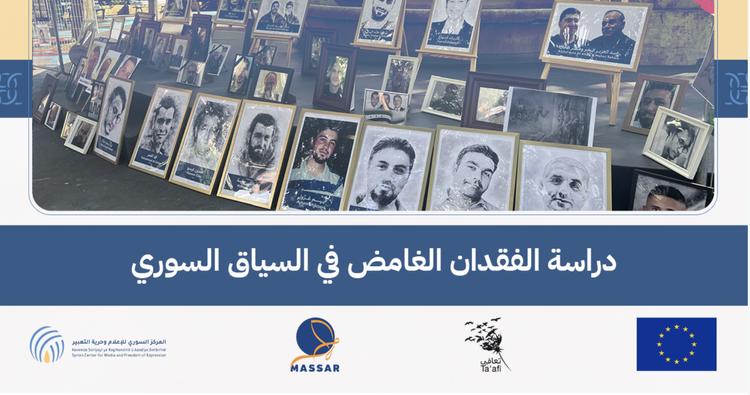
Study: “Ambiguous Loss in the Syrian Context” – Syrian Centre for Media and Freedom of Expression The Syrian Centre for Media and Freedom of Expression has released a study titled “Ambiguous Loss in the Syrian Context,” examining
one of the most painful and complex consequences of the Syrian
conflict: enforced disappearance and the unresolved, open-ended loss it
creates at the psychological, social, and legal levels for tens of
thousands of families. The
study employs a qualitative methodology combining individual
interviews, focus groups, and testimonies from relatives of the
disappeared, activists, and experts, alongside psycho-social analysis of
the concept of ambiguous loss—conditions in which the fate of a missing
person remains unknown, and families are left suspended between hope
and grief. According to the study, this prolonged uncertainty traps
families in an ongoing cycle of pain, denying them the ability to mourn
and forcing them into a state of permanent waiting, exacerbated by the absence of truth and the persistence of impunity. The
report outlines the profound impact of ambiguous loss on individuals
and communities, ranging from psychological trauma to the erosion of
family and social bonds, and the deterioration of legal security and
trust in institutions. It further notes that the scale of disappearances
and missing persons in Syria since 2011 has turned this phenomenon into
a deeply painful societal rupture affecting wide segments of the
population. The
study concludes with a set of recommendations, including the need to
integrate the issue of ambiguous loss into transitional justice
priorities, establish effective mechanisms to document disappearances
and uncover victims’ fates, expand psychosocial support programmes for affected families, and strengthen co-operation between civil society organisations and specialised entities to uphold the right to truth and prevent the recurrence of such violations. To read the full study, visit the link provided. |
|
|
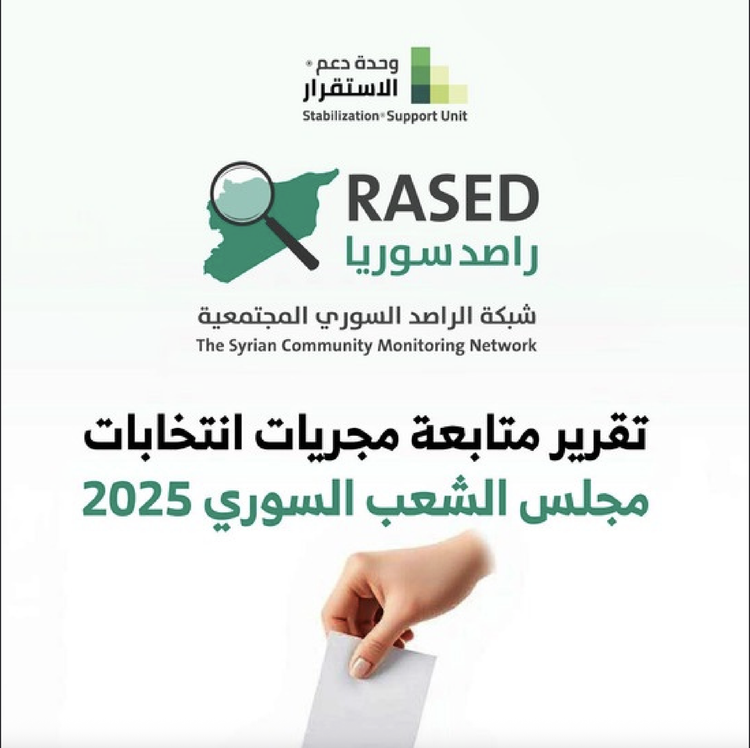
Report on Monitoring the 2025 Syrian People’s Assembly Elections – Syrian Community Monitor Network (Rasid) The Syrian Community Monitor Network (Rasid) has released its report on monitoring
the 2025 People’s Assembly elections, marking one of the first
systematic civil monitoring efforts of an electoral process during the
transitional period. The report draws on extensive field observations
conducted by Rasid teams across multiple polling centres in several governorates, relying on trained monitors and a methodology grounded in internationally recognised monitoring standards. The report provides a detailed overview of the different stages
of the electoral process—from the formation of the Higher Elections
Committee and the nomination procedures, through to election day and the
organisation of polling centres, including the administration of stations and the overall integrity of the voting environment. The findings indicate an overall acceptable level of organisation in most monitored centres,
while also noting several procedural challenges such as varying levels
of preparedness, limited accessibility arrangements, and low
representation of women in supervisory committees. The
report further evaluates the current electoral college system as a
transitional arrangement shaped by the nature of the period, while
underscoring the importance of moving in the future towards direct
nationwide elections that include all Syrians inside and outside the
country. Such a shift, the report argues, would need to be grounded in
an updated national voter registry that ensures fairness and
inclusivity. In
addition, the report outlines a series of recommendations aimed at
improving the electoral process. These include strengthening the
legislative framework, enhancing the independence of the Higher
Elections Committee, improving the readiness of polling centres, increasing transparency in campaign financing, and expanding the role of civil society in electoral oversight and governance. This
report stands as an important civil reference for tracking political
reform processes and contributes to reinforcing transparency and public
confidence in the electoral process during Syria’s transitional phase. To read the full report, visit the link provided. |
|
|
|
|
“Syria’s Transition Through the Eyes of Civil Society” – Cairo Institute for Human Rights Studies The Cairo Institute for Human Rights Studies has released its new report, “Syria’s Transition Through the Eyes of Civil Society,” which
offers a comprehensive reading of the political and social landscape
following the fall of the regime in December 2024. The report examines
the reality of civil society’s work inside Syria and in displacement
contexts, outlining its assessment of the challenges and opportunities
shaping the transitional phase. Relying
on in-depth interviews with a broad range of civil society
practitioners, activists, and researchers, the report provides a
detailed portrait of the civic space after political change. It
highlights that although civil society organisations have witnessed
a relative expansion in the space available for their work, they
continue to face regulatory and legislative constraints that limit their
mobility and influence. Additional
challenges include declining public trust, internal fragmentation, and
the absence of a clear framework for partnership with the transitional
government. The
report also underscores the longstanding role of civil society as one
of the pillars of public life in Syria—particularly through service
provision, documentation of violations, and fostering trust within local
communities. It stresses the importance of protecting civic space,
strengthening the role of independent organisations, and ensuring their meaningful participation in policymaking as an essential component of any national reform or reconstruction process. The
report calls for a review of the legal framework governing civil
society, the adoption of transparent mechanisms that enable broader
participation by civic actors, and the provision of sustained
international support to ensure civil society organisations can fulfil their oversight, service, and rights-based roles throughout the transitional period. To read the full report, visit the link provided.
|
| | |

Comments