|
$$PLAIN_TEXT_PREVIEW$$
Madaniya’s Monthly Newsletter
|
Dear colleagues, representatives of civil society organisations, and members of the press This March—the month of our revolution’s anniversary—was particularly heavy as it was marred by violations across various parts of Syria. Yet it also carried much hope, with celebrations marking the revolution’s anniversary, Nowruz, the onset of Ramadan, and the anticipation of Eid al-Fitr for the first time without the Assad regime. We hope the days ahead bring more hope to us all. Wishing you a blessed time and a happy holiday season. Below is our March newsletter, where we share with you the latest developments in Madaniya and the Syrian civic space. Best wishes,
Madaniya’s Team
|
Updates on Madaniya’s Work
|
A Comprehensive Dialogue on the Role of Civil Society and Madaniya in the Political Transition Madaniya was established with a clear vision calling for an inclusive, democratic, and sovereign Syria, where all citizens are equal under the rule of law. Since its launch, Madaniya has united its member organisations around a clear set of values that guided our collective work for almost two years. With our guiding principle of reclaiming the political agency of the Syrian civic space, Madaniya has thus far focused on safeguarding that space and promoting the leading role of civil society in shaping Syria’s future, in line with our shared values.
|
|

|
|
We are now on the threshold of a new phase to achieve the Syria we believe in. This phase, with its tremendous responsibilities and significant risks—some of which we have witnessed in recent weeks—requires a bold moment of self-reflection and critical examination of our country’s reality and our civic space. It necessitates a clear-eyed assessment of our own positioning and roles as civic actors within that space. Hence, Madaniya recognises the need to reconsider its mission in light of Syria’s profound changes, striving for greater clarity and focus while adhering to our principle of the civic space’s political agency in realising the vision and shared values that guide us.First, this entails tackling the question of the new role of civil society and, consequently, the role Madaniya can play as a collective platform that aspires to bring about the future it envisions through a set of shared values. Second, it involves addressing how Madaniya’s vision and values can be translated into standards and indicators by which we can measure progress. This will allow us to define our roles and hold ourselves accountable accordingly. In addition, an internal review of Madaniya’s operational mechanisms is needed, so we can learn from our past experiences and collaboratively establish more effective guidelines for our joint work. Accordingly, Madaniya will organise a thorough and detailed dialogue process with its member organisations, with the participation of Board members, to explore the questions above (and related issues). We want this to be a genuinely inclusive discussion that is given sufficient time and space to yield outcomes clarifying our respective roles in realising a Syria we believe in. Therefore, the outputs of this dialogue will not only be used to structure Madaniya’s internal environment; they will go beyond that to help outline a roadmap for a civic action that is grounded in our shared vision and values. We will begin this process right after Eid, and we will keep you updated regularly on our progress. In light of this plan, we have decided to postpone the Civil Society Conference—initially planned for April in partnership with Bahar, Baytna, the Local Councils Unit, and the White Helmets—so we do not restrict the conversation to just a two- or three-day event. Instead, we want a genuine, sustained process, culminating in a participatory conference where we can present the results of our dialogue-based efforts.
|
Madaniya's Engagement with Ongoing Events
|
|
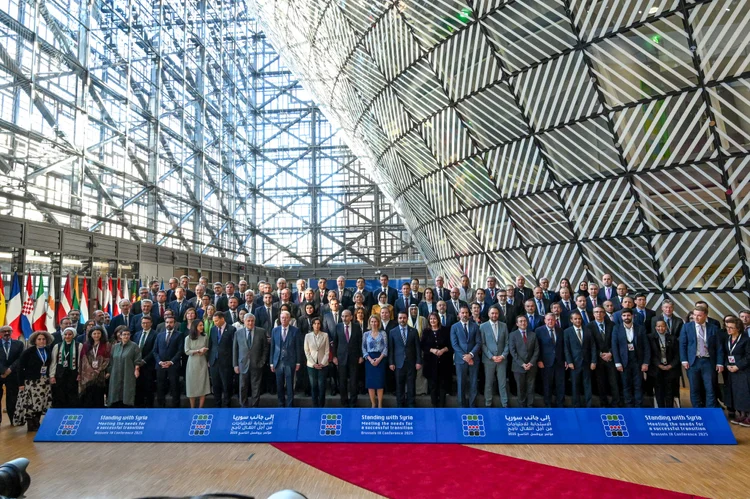
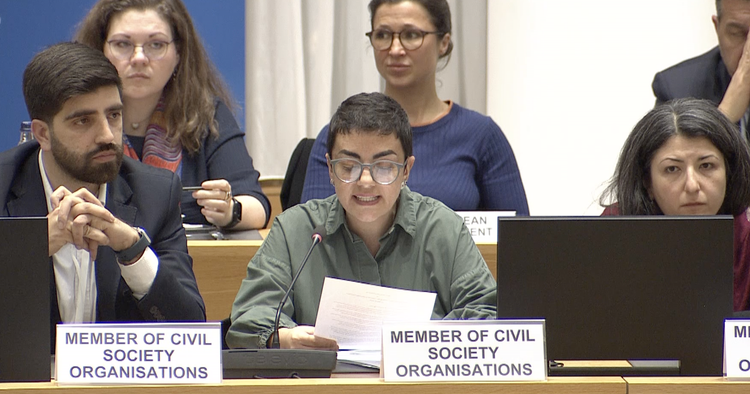
Brussels Conference IX: “Standing with Syria” On March 17, 2025, Madaniya took part in the ninth Brussels Conference, “Standing with Syria,” together with a Syrian civil society delegation. The conference brought together government representatives, international organisations, and humanitarian agencies—and, for the first time, included the Syrian Transitional Government, represented by Foreign Minister Asaad al-Shaibani. Discussions centered on the current situation in Syria and ways to strengthen international support for the political transition, reconstruction, and achieving justice.
|
|
|
|
|
|
|
In its statement, Madaniya emphasised the importance of the international community’s commitment to backing the Syrian political transition, with a focus on justice, accountability, and the rule of law as the foundation for a comprehensive, lasting political solution. Madaniya also underscored the need for an independent and active civic space that would enable genuine civil society engagement in the democratic transformation—reflecting the aspirations of all segments of the Syrian population. It further stressed the necessity to lift certain international sanctions hindering reconstruction and fair, sustainable social and economic recovery. Additionally, Madaniya pointed to the need to reinforce transitional justice processes that protect victims’ rights and hold perpetrators of abuses accountable, both before and after the regime’s downfall. Among the conference outcomes was a commitment from certain donor states to provide financial aid for Syria via international assistance, reaching a total of 5.8 billion euros. These funds are intended to bolster political stability and support long-term social and economic recovery, along with ensuring humanitarian relief for those impacted by the conflict. Participants also reiterated the urgency of accelerating political solutions for Syria and creating mechanisms that guarantee progress in this area.
|
|
|
|
To watch the full statement, visit the available link. For the full statement in English, visit the available link. For the full statement in Arabic, visit the available link.
|
In this section, we highlight the latest reports and updates published by Syrian organisations or about Syria over the past month.
|
|
Legal-Political Reading of the Constitutional Declaration – Syrian Center for Media and Freedom of Expression The Syrian Center for Media and Freedom of Expression (SCM) released a legal and political analysis of the constitutional declaration issued in Syria following the military overthrow of the Assad regime. The center highlights that this declaration fails to meet essential requirements for a transition to a democratic system, noting that a provisional constitutional document was introduced without genuine inclusion of political and societal forces. Furthermore, the military leadership opted for a “Victory Conference,” attended only by armed factions, instead of convening a broad national forum.
|
|
|
|
|
According to this analysis, the constitutional declaration grants extensive powers to the president, disregarding the fundamental principle that sovereignty resides with the people. Meanwhile, the legislative and judicial branches were undermined, with the president effectively appointing members of the People’s Assembly—either directly or indirectly—and retaining a judiciary law that subordinates the judicial system to executive authority. This framework erodes checks and balances and places judicial independence under severe strain. On the human rights front, the center notes persistent discriminatory aspects, such as requiring the president to follow a specific religion and defining Islamic jurisprudence as the primary source of legislation—excluding religious and linguistic minorities. The declaration also fails to explicitly safeguard freedoms such as the right to private communications, access to information, and the rights to protest and strike. It additionally lacks a clear recognition of Syria’s cultural and linguistic pluralism. Regarding transitional justice, the report criticises the exclusive focus on crimes committed by the former regime while neglecting serious violations by other parties, thereby reducing transitional justice to a selective, incomplete approach. Still, the document points out that certain articles could be amended—or new ones introduced—via mechanisms outlined in the declaration, opening a possible path to overcome these shortcomings and lay the groundwork for a more inclusive, participatory, and rights-respecting transition.
|
|
Analysis of the Constitutional Declaration – The Day After The Day After published an analytical overview of the constitutional declaration issued in Syria on March 13, 2025, scrutinising its content and legal-political implications within the post-regime-change context.
|
|

|
|
|
This report acknowledges some constructive elements, such as the declaration’s stated adherence to international human rights treaties, its ban on special courts, and the introduction of transitional justice measures. However, it highlights significant gaps for the post-regime phase. These include granting the president sweeping powers—particularly concerning the selection of People’s Assembly members—and maintaining a judiciary law that ensures the judiciary remains under executive control. While the declaration formally endorses the principle of separation of powers, the actual provisions contain no clear mechanisms for oversight, raising fears of reverting to a centralised, authoritarian model. The report also criticises the heavy reliance on the Victory Conference, held by armed factions, instead of initiating a broad national conference or inclusive dialogue that encompasses the various civil and societal forces. Additionally, the transitional justice articles focus mainly on crimes committed by the former regime, neglecting other violations. Furthermore, the declaration does not establish a precise timeline for drafting a permanent constitution or outline clear structures to ensure widespread participation in that process. In conclusion, the constitutional framework, despite some positive points, does not sufficiently address the establishment of a democratic republic founded on the rule of law and transparent accountability. The study stresses that the success of the transition requires amendments to limit the president’s excessive powers and create truly independent institutions, employing definite measures that include all segments of Syrian society.
|
A Feminist Perspective on the New Syrian Constitutional Declaration – Musawa Musawa shared a feminist reading of the new Syrian constitutional declaration, focusing on issues related to women’s rights during the transitional period. The analysis begins by distinguishing between a constitutional declaration and a permanent constitution—usually the former is confined to overarching principles, whereas the new declaration provides extensive detail, edging closer to a condensed constitution yet omitting vital provisions to ensure genuine women’s participation in shaping the country’s future. According to this paper, the new declaration largely retains entrenched biases against women. Some articles still use predominantly male-centered language, grant broad powers to the president, affirm a specific religion for the head of state, and cite Islamic jurisprudence as the key legislative reference. The study indicates that combining a modern civic vision with a religious framework leads to constitutional contradictions, particularly concerning women’s rights, which are confined to family life or regulated by discriminatory sectarian laws. The reading further criticises the absence of detailed structures that would guarantee equitable civil and political freedom, including the fact that members of the People’s Assembly are effectively subject to executive oversight. Concerning women’s rights specifically, the declaration omits the right for women to pass on citizenship to their families, and it does not offer clear guidelines for women’s inclusion in transitional justice committees or for protecting survivors of sexual violence and discrimination. Moreover, some terms—like “public order” or “public morality”—are vaguely defined, allowing them to be exploited to limit general freedoms, women’s rights included. The paper calls for concerted efforts to involve women in drafting the permanent constitution, along with transparent frameworks that ensure women’s real participation in all decision-making processes, from constitutional to electoral affairs. It also advocates adopting a system grounded in equality of citizenship, judicial independence, and legislative clarity—while fostering broad social dialogues that promote a culture of rights and liberties and support a transitional justice process that excludes no one and discriminates against no group, including women.
|
| | |

Comments