|
$$PLAIN_TEXT_PREVIEW$$
Madaniya’s Monthly Newsletter
|
Dear Colleagues, representatives of civil society organisations We hope you have had a productive month!This month, we have witnessed rapid developments in the Syrian political landscape, particularly concerning normalisation with Turkey and several European Union countries. Alongside these developments, there have been continued severe violations against Syrian refugees in Lebanon, as well as escalating violence, assaults, and forced deportations of Syrian refugees in Turkey. We have also seen ongoing movements demanding rights across Syrian territories, from Sweida in the south to Idlib, northern Aleppo countryside, and Qamishli in the north. This situation raises a pressing question about our role as active participants in the civic space, a question we hope to explore and engage with in a manner befitting the significance of this political moment. Below is our July newsletter, where we share with you the latest developments in Madaniya and the Syrian civic space. Best wishes, Madaniya’s Team
|
Updates on Madaniya’s Work
|
|
|
Madaniya’s Volunteers Pool
|
|
|
|
|
Over the past months, we have been working on developing the Madaniya Volunteers Pool initiative, which aims to bridge the gap between young Syrian professionals inside and outside Syria and our member organisations. This initiative recognises the multiple talents and expertise possessed by many professionals eager to engage in Syrian civic work. It is designed to channel these skills in ways that support and enhance the efficiency of the Syrian civic space. In line with Madaniya's vision, goals, and core values, this initiative aspires to bolster our collective efforts toward working on Syria's future. Our primary goal is to enhance access, engagement, and professional development for volunteers while ensuring their effective participation in all aspects of civic work related to Syria. Today, the Madaniya Volunteers Pool comprises over 50 volunteers with a wide range of expertise covering administrative tasks, creative aspects, communication skills, technical competencies related to information systems, digital security, and more.
|
|
|
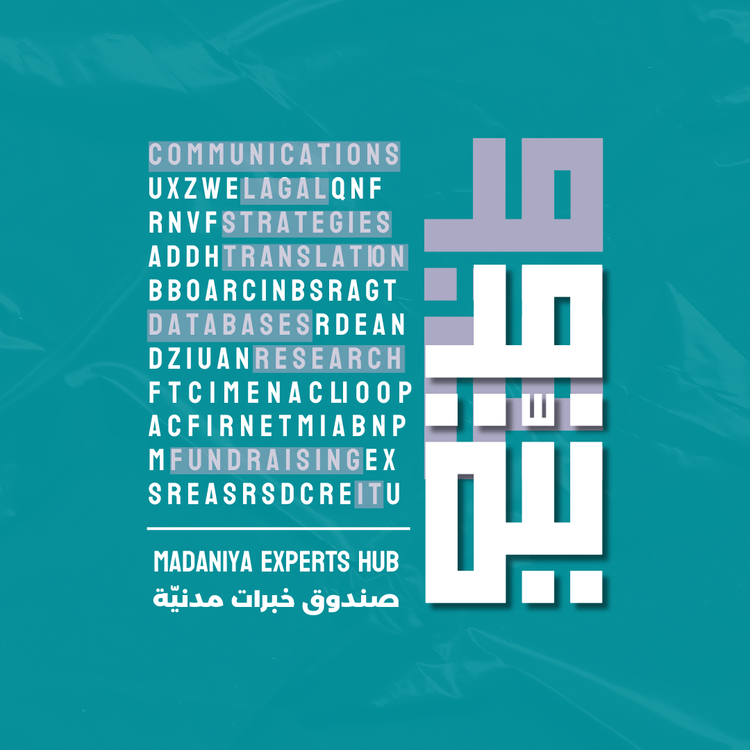
Madaniya Experts Hub Last month, we launched the Madaniya Experts Hub, which comprises a group of individuals and institutions with technical expertise in various fields. The aim is to enhance the institutional, programmatic, and operational capacities of our member organisations. Through this Hub, experts will provide their services to Madaniya member organisations at subsidised and affordable rates, according to contractual terms specifically designed to meet the needs and capacities of the member organisations. The first partnerships within the Expertise Fund have been established with the Al-Jumhuriya Group and its editorial arm, DocStream. We previously shared a partnership survey link that will enable Al-Jumhuriya and DocStream to understand the linguistic needs and develop customised service packages for Madaniya members, and in return, Member organisations will receive a 20% discount on all DocStreams services. In a similar vein, we are currently working with "Syria Report" to create a mechanism that allows our member organisations to access its digital archive, datasets, reports, and research, as well as its research services, through collective access accounts. |
|
|
|
Advancing National Dialogue on the Political Process in Syria in Accordance with UNSC Resolution 2254 In the past months, we shared with you the news about the launch of the project "Enhancing National Dialogue on the Political Process in Syria in Accordance with UNSC Resolution 2254," an initiative by Madaniya, coordinated with several Syrian civil society organisations both inside and outside Syria. This project aims to create a general vision reflecting the perspectives of a broad group of Syrians on UNSC Resolution 2254 as an access point to a political solution in Syria, based on political, governmental, and security changes on both national and international stages. We have now completed the first round of dialogues, which included 13 dialogue workshops in Sweida, Damascus, Rural Damascus, Hama, Latakia, Idlib, Azaz, Deir ez-Zor, Qamishli, and Raqqa, in addition to three virtual dialogue workshops involving civic actors in neighboring countries and the diaspora. Many of Madaniya's member organisations invested their time in these dialogues, where each workshop discussed four main themes: the political process, the transitional governing body, constitutional reform, and national elections. The research team and the steering committee overseeing the project will analyse the discussion outcomes and produce a report to be shared with Madaniya member organisations in the coming weeks. The discussion outcomes will feed into the agenda of the annual conference scheduled for the last quarter of this year. This conference will be the first opportunity to discuss these outcomes and develop ideas on how to build on them in preparation for the second phase of the project.
|
The Syria Strategy Project Work continues on the Syria Strategy Project, in which Madaniya collaborates with the Atlantic Council, the Middle East Institute, and the European Institute of Peace. The technical working groups have completed the first of four planned discussion rounds. These groups include a broad range of Syrian and international experts and facilitate in-depth discussions on six key topics: the humanitarian situation, economic recovery, governance, security conditions, the justice and accountability process, and the political process. The goal is to develop policy recommendations for the short, medium, and long term to address the Syrian issue. The project also periodically organises bilateral meetings with relevant stakeholders, including representatives of key countries involved in the Syrian issue from the United States, Europe, neighboring countries, and Arab states, as well as representatives of various political and UN bodies. These meetings aim to discuss the proposals being developed in the working groups and ensure they are practical and receive local and international support, thus advancing Syrian and international interests in Syria's future. Currently, efforts are underway to summarise the recommendations that emerged from the first round of discussions. |
|
|
|
Madaniya’s Engagement with Ongoing Events
|
Political Normalisation: Turkey and the European Union In light of recent developments concerning attempts to politically normalise relations with the Syrian regime, Madaniya is working in collaboration with a group of member organisations and interested individuals to formulate a Syrian civic stance on the normalisation issue. The normalisation efforts which began with the Arab initiative, has recently accelerated through the Turkish path and the reconsideration by some European countries of the EU's strategy towards Syria. The aim of this coordinated effort is to establish a clear stance that can be communicated to representatives of the countries and governments involved in this matter. Madaniya will request bilateral meetings to discuss this position with ambassadors, special envoys, and relevant representatives in Turkey, the UK, the EU, and the US, with delegations from the Syrian civic space in attendance. Simultaneously, plans are underway to hold a Syrian press conference in Brussels on these developments and on the sidelines of the United Nations General Assembly in New York in September. We are also exploring of the possibility for a representative from the Syrian civic space to provide a briefing on these developments at the Security Council session in September. For any inquiries or interest in participation, please contact us.
|
Early Recovery Given the issues with the draft "Early Recovery Strategy for Syria" and the accompanying terms of reference for the Early Recovery Trust Fund, which were shared by the UN Office for the Coordination of Humanitarian Affairs earlier this year, and in light of the lack of transparency in the production of this draft, which was marred by speculation and a lack of official communication, a group of Syrian organisations has prepared a position paper on the draft strategy and the terms of reference for the Early Recovery Trust Fund. This paper is the result of a collective effort by numerous Syrian actors in the fields of humanitarian work, development, and human rights, following a series of intensive consultations over the past few months since speculation about the draft strategy began. The main goal of this paper is to support the participation of Syrians in decision-making, including Syrian representatives in the Syria Strategic Group (SSG), enabling them to advocate for broader and more effective Syrian participation in the processes of thinking, designing, and formulating solutions related to the Early Recovery Strategy and the Trust Fund. This approach aims to address legitimate concerns associated with the current proposals and considers the multiple complexities of the Syrian context. The drafting committee of this paper calls for initiating a collective process in which concerned Syrian organisations collaborate to discuss and develop a roadmap that reflects their vision for the Early Recovery Strategy and its associated Trust Fund. This vision should take into account the various humanitarian, political, legal, and technical aspects of the issue and transition from an internationally-led response to a systematically Syrian-led approach.
|
Updates on the Work of Member Organisations
|
In this section, we review the achievements and developments in the work of Madaniya's member organisations.
|
Games Wide Open (for War Criminals) Before the start of the Olympic Games in Paris on July 26, the Syria Campaign, supported by over 700 activists and civil society organisations, called on the International Olympic Committee (IOC) to ban war criminal Omar Al-Aroub, who was expected to be part of the leadership of the Syrian Olympic team. Omar Al-Aroub oversaw the suppression of student protests during the Syrian revolution, ordering the arbitrary arrest and torture of students while leading the National Union of Syrian Students. The campaign intensified pressure to ban Al-Aroub from the Olympics through a global petition, writing letters to the IOC, demonstrating in Paris, and actively engaging on social media. These efforts successfully led the IOC to confirm that Al-Aroub would not be officially welcomed at the Olympic stadium. You can read more about the campaign through the available link. |
|

|
|
What Happens After The Forced Deportation Of Refugees From Lebanon? The Access Center for Human Rights has released an investigative report revealing details of the indiscriminate security campaign conducted by Lebanese authorities aimed at forcibly deporting Syrian refugees from Lebanon since 2023. The center documented 1,080 cases of arbitrary arrest and 763 cases of forced deportation to Syria from the beginning of 2023 until December 30 of the same year. The center shares testimonies obtained from victims, describing horrifying events and violations they faced from the moment of security raids on their residences, their arbitrary arrests, and subsequent transfers to Lebanese army barracks. During interrogations, they were subjected to beatings, insults, harassment, and bullying. They were then collectively transported to border crossings and handed over to Syrian authorities illegally. This marked the beginning of another phase of violations by Syrian authorities, including security interrogations, military, political, and civil settlements, arbitrary arrests, and detentions by military courts. The testimonies indicated the potential coordination at various levels between the two countries for receiving the deported refugees at the Lebanese-Syrian border, involving the Lebanese army, the Syrian army, the Syrian Army's Fourth Division, smuggling gangs, and some Lebanese army personnel. The report includes recommendations for the Lebanese government, notably to adhere to Article 3 of the Convention Against Torture as guaranteed by the Lebanese constitution, grant refugees legal protection, halt the plan to repatriate refugees, and stop their forced deportation to Syria. To read the full report in English, please visit the provided link. |
|
|
|
| | |

Comments