|
$$PLAIN_TEXT_PREVIEW$$
Madaniya’s Monthly Newsletter
|
Dear colleagues, representatives of civil society organisations, We hope this finds you in good health and spirits. Below is our newsletter for December 2025 and January 2026, where we share with you the latest developments within Madaniya and across the Syrian civic space. Best wishes,
Madaniya’s Team
|
Updates on Madaniya’s Work
|
|
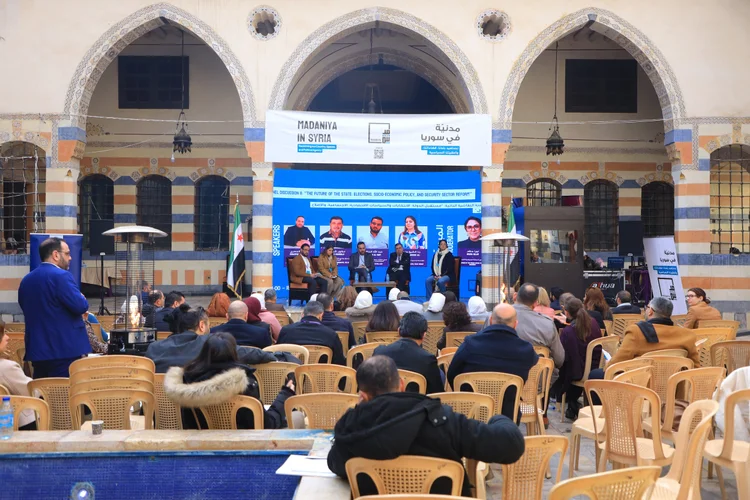
Conference on the Indicators of the Political Transition Observatory in Syria Madaniya,
in partnership with The Day After, has concluded the first phase of the
Political Transition Observatory in Syria project, culminating in the
Conference on the Indicators of the Political Transition Observatory.
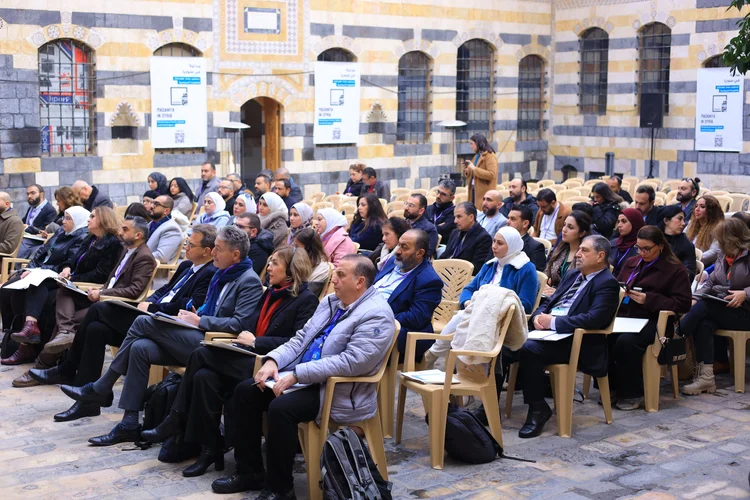
The conference was held on 21 December 2025 and provided a platform to
present the preliminary framework of indicators for measuring the
transitional phase. This framework draws on the outcomes of more than 71
dialogue sessions and workshops conducted across various regions of
Syria, in addition to extensive virtual consultations, with the
participation of over 1,500 actors from diverse backgrounds and
locations. It was developed through a bottom-up, participatory approach
that takes into account the specificities of the Syrian context and the complexities of the transitional period. |
|
|
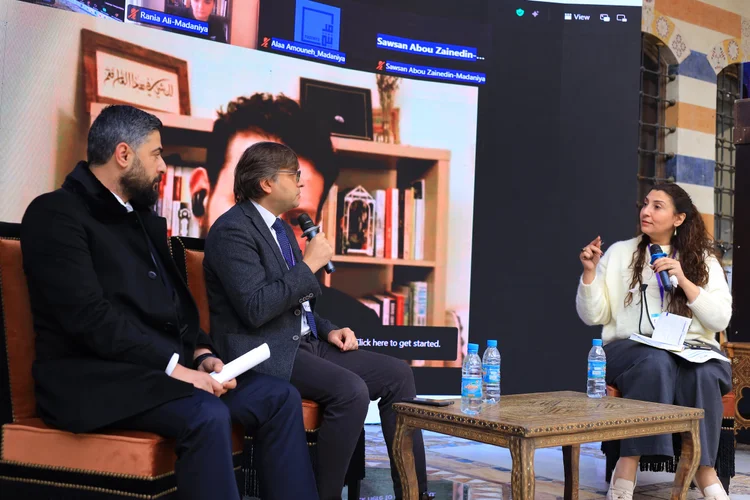
The
conference discussed six core pillars that served as the foundation for
building the indicators: transitional justice; constitutional and
judicial reform; elections; economic and social policies; and security
sector reform. These themes were explored through specialised discussion
sessions bringing together researchers and experts, civil actors,
representatives of civil society organisations, and legal, economic, and
security professionals. The discussions focused on the critical
questions that emerged from local dialogues, as well as the structural
and institutional gaps that shape the trajectory of the transition and
affect the ability to measure progress. The
conference aimed to open an in-depth discussion on the methodology for
developing the indicators, the standards for measuring them, and their
limitations and potential as an independent civil tool to monitor the
performance of the state and its institutions during the transitional
phase. It also sought to help identify priorities for collective action
in advancing the political transition in line with a shared set of
values. In this context, a preliminary matrix of political transition
monitoring indicators was presented, developed through an analysis of
sectoral dialogue outcomes and their linkage to cross-cutting
dimensions, enabling a comparative and systematic reading of reform
trajectories. |
|
|
|
|
With
the conclusion of the conference, Madaniya and The Day After
are entering a new phase of participatory work. This phase
will focus on completing the development of the matrix, regularly
updating the indicators, and expanding dialogue with local actors and
experts, in preparation for adopting the final formulation of the
indicators as part of civil monitoring tools in the period ahead. To view the matrix in Arabic, follow the available link. |
|
|
|
|
|
Developing Madaniya’s Strategy for 2026–2028 Madaniya
is currently developing its strategy for the 2026–2028 period, within a
three-year planning process aimed at strengthening its role as a
coalition of Syrian civil society organisations and at defining its strategic priorities at a pivotal moment in the political transition. This process is grounded in a participatory and incremental methodology, designed to accompany member organisations through successive stages, each building on the outcomes of the previous one, with the aim of ultimately shaping Madaniya’s strategic objectives and overarching approach for the coming phase. In this context, an open-ended survey was developed and shared with member organisations. Its relatively open format was intended to minimise
preconceived framing of responses and to allow greater space for
critical reflection and in-depth analysis, in line with the complexity
of the political and societal context in which Madaniya and Syrian civil society operate. Alongside the survey, a series of participatory meetings were held with Madaniya’s
members, including five focus groups, each lasting approximately two
and a half hours. These sessions focused on discussing the strategic
direction, Madaniya’s roles, and work priorities for the coming years. They enabled in-depth dialogue on challenges and opportunities, and contributed to testing the strategy’s initial assumptions while grounding them in the practical realities of members’ work across diverse contexts. This planning process is based on a collective working methodology, aimed at ensuring that the final strategy reflects the perspectives, analyses, and views of Madaniya’s
members, its Board of Directors, and its executive team. In recognition
of the responsibility borne by civil society towards the public
interest and Syria’s future at this historic juncture, Madaniya, as a coalition of more than 250 Syrian civil society organisations,
seeks to develop a strategic framework that is as inclusive, realistic,
and implementable as possible, and that responds effectively to the
requirements of the next phase. The
final strategy is expected to be completed in early March and will be
published and made publicly available upon its adoption, serving as a
reference document to guide Madaniya’s work in the period ahead.
|
|
|
|
|
|
Madaniya's Engagement with Ongoing Events
|
|
|
Madaniya’s Statement Marking One Year of the Political Transition in Syria On 8 December 2025, Madaniya issued a position statement on the course of the political transition in Syria, in light of the political developments that followed the fall of the Assad regime on 8 December 2024. The statement is grounded in Madaniya’s vision and founding values, and reflects the responsibility of civil society to accompany
this critical phase and to contribute to steering it towards the
construction of a state based on equal citizenship, the rule of law, and
respect for human rights. |
|
|
|
|
The position statement was informed by an extensive series of dialogue sessions and consultations with Madaniya’s members inside and outside Syria, in addition to a review of previous position papers and interactive discussions with civil and political actors. This process constituted
a form of constructive and critical engagement with official narratives
related to the transitional phase, particularly those articulated by
the transitional authorities on national and international occasions. The statement sets out Madaniya’s
perspective on the political transition, underscoring the need for a
clear and well-defined roadmap grounded in the principles of
participation, transparency, and accountability, and one that allows the
steps of the transition to be subject to public debate, measurement,
and monitoring. It also stresses the importance of civil society’s role
as a key partner in public policy formulation, performance oversight,
and rights advocacy, in ways that strengthen the prospects for
democratic transition and prevent the reproduction of exclusionary or
authoritarian patterns. The statement further highlights the importance
of Syrian–Syrian dialogue as a central tool for rebuilding trust and forging sustainable national understandings. Madaniya
argues that such dialogues must be inclusive, open, and multi-layered,
and should not be reduced to symbolic initiatives or one-off meetings.
Rather, they should evolve into an ongoing process that enables the
expression of Syria’s political and social pluralism and leads to
actionable understandings that support the transition, safeguard the
country’s unity, and lay the foundations for a new social contract based
on equal citizenship and respect for diversity. The
statement addresses key areas of reform during the transitional phase,
including transitional justice and uncovering the fate of the missing, constitutional
and judicial reform, the establishment of a fair and inclusive
electoral system, and the restructuring of the security sector. It also
highlights the necessary economic and social reforms required
to address the impacts of the war and to protect the most vulnerable
groups. In addition, the statement affirms the need to build legitimate
transitional institutions, ensure genuine separation of powers, and
protect public freedoms and civic space. The statement concludes by emphasising that the success of the political transition remains
contingent on a genuine partnership between the transitional
authorities and civil society, as well as on supportive international
engagement that respects Syrian agency and does not substitute for it.
In this context, Madaniya
reaffirms its readiness to continue constructive engagement throughout
the transitional phase by offering analyses and recommendations, and by
contributing to the development of monitoring and accountability tools,
in line with the aspirations of Syrians for freedom, dignity, and
justice. To read the full statement, follow the available link.
|
Updates from member organisations
|
This section highlights the key achievements and recent developments in the work of Madaniya’s member organisations, along with events held at Madaniya’s headquarters in Damascus.
|
|
|
Joint Statement on the Military Escalation in North-East Syria A group of Madaniya member organisations issued a joint statement addressing the security and humanitarian developments in north-east Syria, in light of
the escalation of military operations and the renewed violence in
populated areas, which has been accompanied by widespread fear and
displacement among civilians. The statement comes amid growing concern
over the fragility of existing understandings, particularly following
the agreement reached on the twenty-first of this month between the
Syrian transitional government and the Syrian Democratic Forces, which
aimed to secure a ceasefire and open a pathway for integration into
Syrian state institutions. The statement notes that the current moment constitutes
a real test of the possibility of moving away from a logic of armed
confrontation towards approaches that place the protection of civilians
at the forefront. The signatory organisations
warn that the continuation of military escalation, especially as the
timeframe stipulated in the agreement nears its end, threatens to
undermine any prospects for stability and to reproduce cycles of
violence and displacement, at a time when there is an urgent need for
practical measures that protect lives and uphold human dignity. The
statement includes a clear call for an immediate cessation of military
operations and stresses the obligation of all parties to respect
international humanitarian law, including refraining from targeting
civilians and civilian infrastructure. It further emphasises
that the protection of the population is not a temporary measure or one
contingent on shifting power dynamics, but rather a legal and moral
responsibility that must form the foundation of any future security or
political arrangements. The organisations
also affirm the importance of preserving the political track opened by
the recent agreement and developing it towards a broader dialogue based
on political solutions and Syrian–Syrian understandings, as the only
viable path to addressing the root causes of the conflict, strengthening
social peace, and preventing a renewed slide into violence. The statement was signed by Syrian civil and human rights organisations that are members of Madaniya, including: the Syrian Program for Legal Development, Alternative Pathways, Justice for Life, PIL – Civil Waves, the Syrian Center for Justice and Accountability, the Campaign for Syria, Nihna Qaddha, the Access Center for Human Rights, Dawlaty, Ta’azur (Synergy), Lilun, The Day After, the Local Development and Small Projects Support Office, For Feminism, and Women Now for Development. The statement concludes by underscoring that consolidating the ceasefire, strengthening dialogue, and protecting civilians constitute
essential entry points for any sustainable stability, and that
disregarding these elements will only deepen societal divisions and
prolong human suffering. To read the full statement, follow the available link. |
|
|
|
Needs Assessments – Stabilisation Support Unit As part of its ongoing efforts to support early recovery and strengthen evidence-based responses, the Stabilisation Support Unit (SSU) carried out a series of field-based needs assessments across a number of
Syrian cities and areas during 2025 and 2026. These assessments were
based on field surveys and direct community consultations, conducted
with the participation of local actors
and affected residents. They aimed to provide a grounded analysis of
existing gaps in infrastructure, basic services, and livelihoods, in order to inform the design of interventions that are better tailored to local contexts. In
the city of Homs, the assessment focused on the cumulative impact of
years of destruction and economic decline. It highlighted widespread
deterioration in water, electricity, and sanitation networks, growing
pressure on health and education services, and high unemployment rates
alongside declining access to stable income opportunities. The findings
underscored the fragility of the recovery process and the need for
integrated approaches that combine infrastructure rehabilitation,
livelihoods support, and strengthened local governance capacities, in order to reduce the vulnerability of the most affected groups and help restore a minimum level of social and economic stability. In Muadamiyat
al-Sham, in the Rural Damascus area, the assessment drew attention to
challenges associated with the return of large numbers of residents and
displaced people amid severe degradation of infrastructure and basic
services. It identified significant gaps in water supply, sanitation, and waste management, alongside high unemployment levels and the absence of stable income sources for a large proportion of households, with women and youth particularly affected. In response, the Stabilisation Support Unit proposed recovery approaches that generate immediate employment opportunities, including labour-intensive programmes, support for small businesses, and vocational training, alongside service improvement and strengthened community participation. In the Sheikh Maqsoud and Ashrafieh neighbourhoods of Aleppo, the Stabilisation
Support Unit conducted a needs assessment following security
developments that affected displacement and return dynamics and the
continuity of services. The assessment found that electricity represented
the most critical gap across sectors, with direct repercussions for
water, health, education, and livelihoods, in addition to fuel shortages
and the deterioration of certain public services. It also pointed to
widespread damage to livelihoods, alongside strong community readiness
to engage in recovery activities linked to neighbourhood and service rehabilitation, with the potential to enhance employment and income opportunities. To access these assessments and other studies produced by the Stabilisation Support Unit, follow the available link.
|
Initiatives for Film Screenings and Artistic Collaborations – Ettijahat - Independent Culture Ettijahat
– Independent Culture continues to implement its initiatives in support
of cultural and artistic practice in Syria. It is currently receiving
applications for the second cycles of the Narratives of Today and Naseej initiatives for 2026, building on the programmes launched in 2025. Under the Narratives of Today initiative, Ettijahat
has opened the call for applications to support touring film
screenings, following the conclusion of the first cycle, in which the
selection committee supported four cinema screening tours that travelled
across several Syrian cities and rural areas. These tours offered a
diverse programme
of Syrian films produced over the past decade, alongside earlier works
that had not previously been accessible to audiences inside Syria. They
contributed to the creation of collective viewing spaces and public
discussions around contemporary artistic, political, and social issues.
The initiative aims to strengthen the right of Syrian audiences to
access Syrian cinema, while enabling filmmakers to present their work to
diverse audiences in varied local contexts. In parallel, Ettijahat continues to receive applications for the second cycle of the Naseej initiative, which in its first round focused on supporting artistic collaborations between different cultural
entities, or between institutions and individuals. In 2025, six
artistic collaborations were supported across six Syrian cities,
spanning a range of fields including music, theatre, visual arts, and
multidisciplinary artistic practices. The initiative seeks
to empower cultural and artistic practitioners to develop collaborative
spaces and to reach diverse audiences through touring performances and
joint artistic encounters. For more information on both initiatives, including eligibility criteria and application procedures, visit the following link.
|
Events at Madaniya Headquarters – Damascus
|
Throughout December 2025 and January 2026, Madaniya hosted a series of cultural, legal, and policy-focused events at its headquarters in Damascus, bringing together local organisations, international partners, and a wide range of civil society actors.
|
|
Syrian Cinema Council Discussion Session – Stories Film On 3 December 2025, Madaniya
hosted a discussion session at its premises that brought together a
group of filmmakers and cinema professionals with a representative of
the Syrian Cinema Council, to explore avenues for cooperation and possible forms
of support to advance the cinematic and cultural landscape in Syria.
The session discussed proposals currently being developed by the Syrian
Cinema Council in its capacity as a service-oriented structure
supporting professionals in the sector, with the aim of fostering a more
sustainable and dynamic cinematic environment and opening new horizons
for production, collaboration, and networking among actors in the field. Workshop on Production Mechanisms, Markets, and Presenting Documentary Films on Different Platforms – Stories Film On 5 and 6 December 2025, Madaniya hosted an intensive workshop organised by Stories Film, featuring film producer Guevara Nimer.
The workshop focused on documentary film production mechanisms,
understanding market dynamics, and how to present documentary projects
to different platforms. It brought together a number of
directors and producers working in the film sector and offered an
in-depth examination of the producer’s role in developing documentary
projects and building professional pitching dossiers tailored to
international markets and platforms. The workshop contributed to
strengthening opportunities for Syrian films to reach wider exhibition
spaces and represented
a further step towards bridging the gap between ideas and funding, and
between creative ambition and the practical realities of documentary
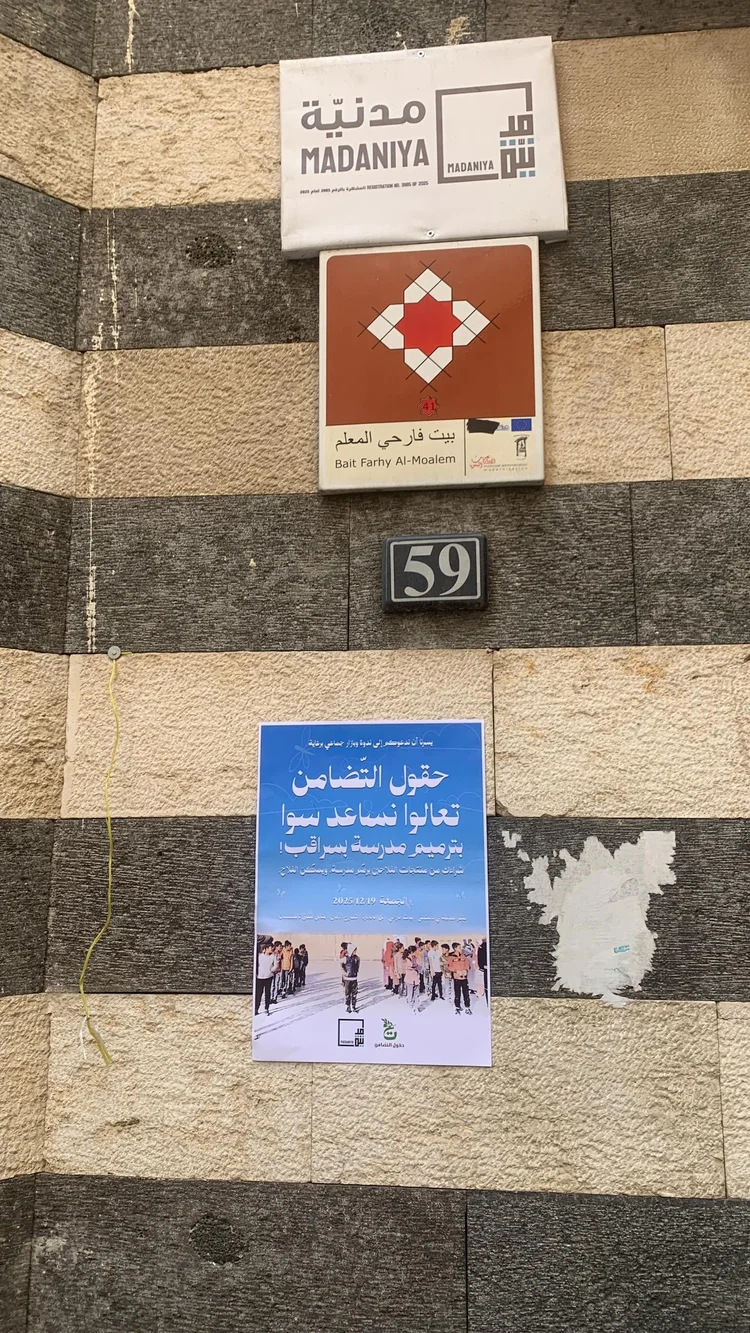
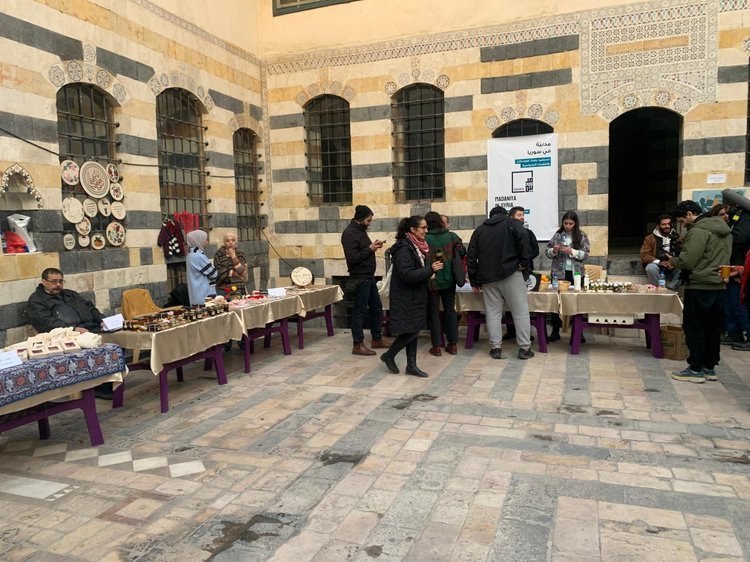
filmmaking. Fields of Solidarity Event On 19 December 2025, Madaniya hosted the Fields of Solidarity event
at its premises. The initiative brings together sustainable
agriculture, art, and music, and aims to document experiences of
agricultural and community-based work, while highlighting agriculture as
a space for solidarity, resilience, and livelihood-building. The event
featured an exhibition of natural agricultural products produced by
farmers working according to organic practices free from chemical fertilisers
and pesticides, alongside displays of handicrafts, artistic works, and
local products. It also included a photo exhibition documenting the
activities of the Fields of Solidarity team in several Syrian areas,
including Mishtaya
al-Hilu, Tartous, Idlib, and Eastern Ghouta. The event was complemented
by the screening of a short documentary tracing the initiative’s
journey from Greece to Syria, and concluded with a modest musical evening held as part of the programme. Dialogue Session: “How Can We Establish a Fair and Inclusive Legal System in Syria?” – Democratic Change Center On 11 January 2025, Madaniya hosted a dialogue session at its premises titled “How Can We Establish a Fair and Inclusive Legal System in Syria?”, organised by the Democratic Change Center in cooperation with Zayla and the European Centre for Kurdish Studies. The session brought together a number of researchers and experts in the fields of transitional justice, law, and constitutional affairs.
Discussions focused on the fundamental relationship between
transitional justice and the establishment of a fair and inclusive legal
system, and on its role in rebuilding trust within Syrian society after
years of violations, as a key entry point for laying the foundations of
Syria’s future constitution on principles of justice, accountability,
and equal citizenship. Tadweer–Tech Event On 8 January 2025, Madaniya hosted the launch event of the Tadweer–Tech initiative at its premises. Tadweer–Tech
is an environmental project that aims to transform waste from an
environmental burden into a reusable resource and a source of energy.
The initiative promotes a vision centred
on waste separation at source, the dissemination of recycling culture,
and the building of community partnerships that begin in schools and
extend to households, with the longer-term objective of advocating for public policies that support a more sustainable environment in Syria. Tadweer–Tech seeks
to raise environmental awareness and to link individuals’ everyday
practices to long-term development pathways that contribute to resource
protection and improved quality of life.
|
In this section, we highlight the latest reports and updates released by Syrian institutions or concerning Syria over the past month.
|
|
|
Report on the Right of Families of the Missing Along Migration Routes to Know the Truth The
Syrian Center for Media and Freedom of Expression published a legal
paper addressing the right of families of the missing along migration
routes to know the truth, drawing attention to one of the most complex
and neglected humanitarian issues associated with asylum and migration
pathways. The
paper examines the reality of the disappearance of thousands of people
during attempts to cross land and sea migration routes, and the
resulting long-term suffering of their families, particularly in the
absence of information, the fragmentation of responsibilities, and the
weakness of cross-border search and documentation mechanisms. It demonstrates that the ongoing uncertainty surrounding the fate of the missing constitutes not only a violation of the victims’ dignity, but also leaves their families in a state of enforced waiting, undermining their ability to mourn, to claim their rights, or to organise their legal and social affairs. The
paper affirms that the right to know the truth is an autonomous legal
right, guaranteed under international human rights law and international
humanitarian law, and that it entails clear obligations on states.
These include the duty to search and investigate, to collect and
preserve information, to inform families of any available findings regarding
the fate of their loved ones, and to ensure the dignified and
transparent management of cases of missing persons and human remains. The paper also highlights the gaps in existing responses, whether in terms of international cooperation, information-sharing, or the establishment of effective databases. It calls for a more coordinated approach that recognises
families of the missing as rights-holders, rather than as marginal
actors within migration and asylum policies. The paper concludes with a
set of recommendations aimed at strengthening existing international
frameworks and developing monitoring and accountability mechanisms to
ensure that this issue is not sidelined under security or political
considerations. It urges that disappearances along migration routes be
addressed as a humanitarian and human rights matter requiring
sustainable responses that respect the dignity of the victims and the
right of their families to truth and justice. To access the paper, follow the available link. |
|
|
Civil Society Operating Environment and the Legislative Framework – Justice for Life Justice for Life published a policy paper examining the legislative framework governing the work of civil society organisations in Syria, in light of
the political and administrative transformations that followed the fall
of the regime and the challenges and opportunities they have generated
during the transitional phase. The paper seeks
to contribute to the public debate on the future of state–civil society
relations, drawing on local experiences and the perspectives of civil
actors from different regions and contexts. The paper adopts a participatory methodology, based on focused discussion sessions with activists and representatives of civil society organisations in a number of
governorates, including areas under the transitional government and
others under autonomous administration. It presents a critical analysis
of the current Associations Law, showing how it entrenches a model built
on prior control and administrative restriction, and how it limits the
independence of civil society and its ability to play a meaningful role
in public affairs beyond narrow service delivery and humanitarian
functions. The
paper discusses a set of key issues, including procedures for
registration and dissolution, restrictions on funding, requirements for
prior approval of activities, and the limited space available for civic
action and public expression. It also highlights differences between
operating environments across regions, and how these affect organisations’ capacity to respond to community needs and to build balanced relationships with local authorities and donors. The paper concludes by emphasising that the transitional phase represents
an opportunity to redefine the legislative framework on new
foundations, shifting civil society regulation from a logic of
“licensing and control” to one of “notification and accountability,”
while guaranteeing freedom of association, financial independence, and
the protection of civic space. It calls for the drafting of a new law
through participatory processes that recognises civil society as a partner in state-building, rather than as an entity subject to security and administrative oversight. To access the paper, follow the available link. |
|
| | | |

Comments